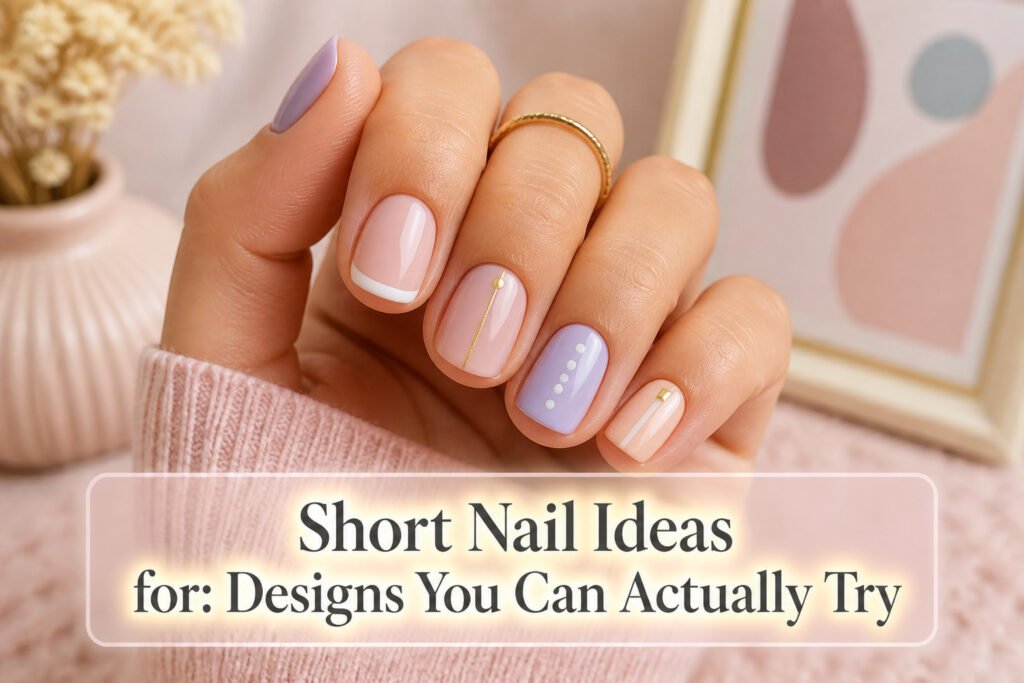
Short nails reward restraint more than long ones ever do. The difference between a design that elongates and one that visually truncates comes down to a single rule: keep every element vertical or tiny, never wide or heavy. A micro-French line at the free edge, barely a millimeter thick, stretches the nail bed where a classic thick white tip would box it in. That same logic holds across every idea below.
1. Micro-French
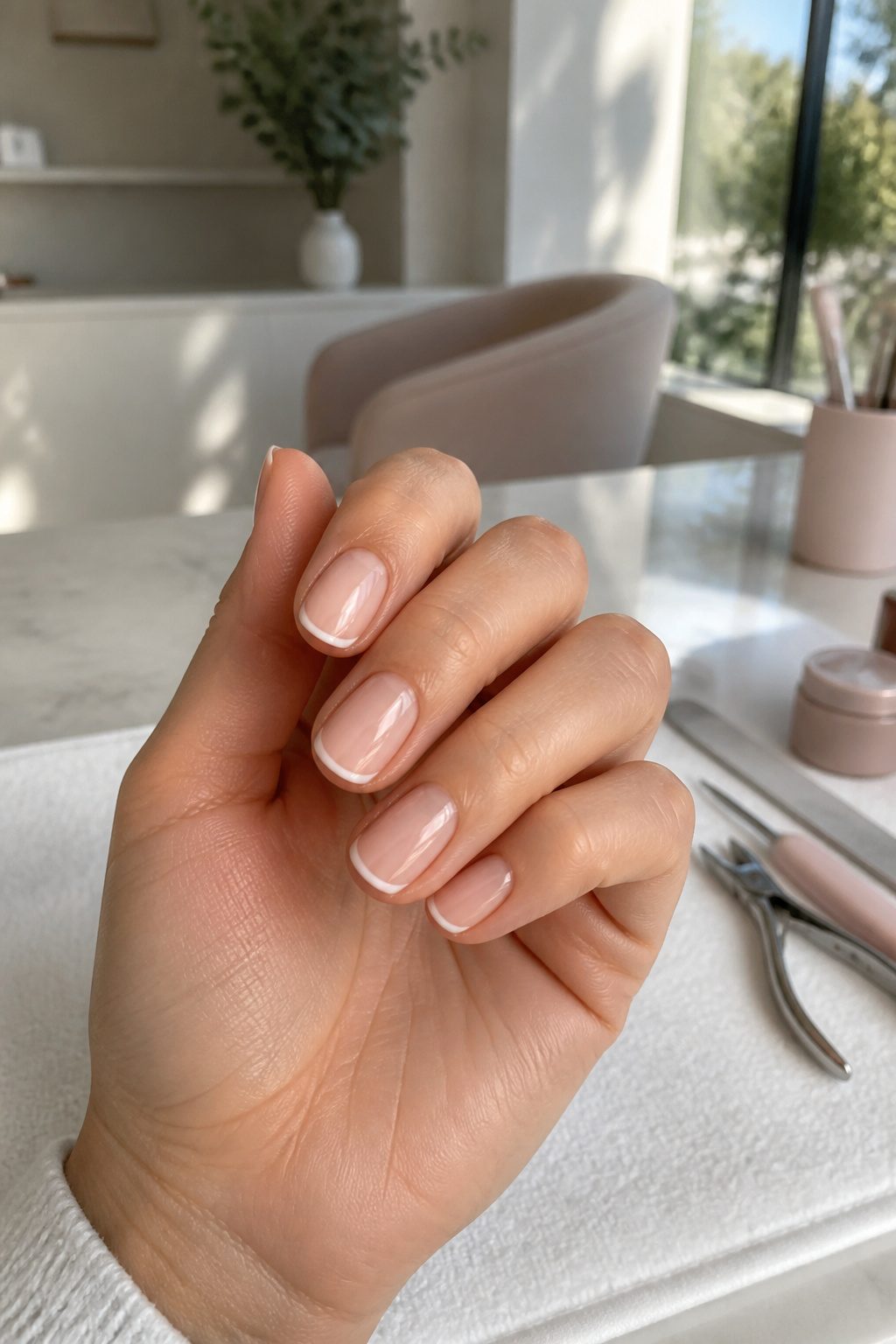
Betina Goldstein coined the micro-French as a thin-line alternative to the classic French manicure, and the difference on short nails is immediate. Where a traditional thick white tip visually shortens the nail bed, the micro-French keeps the painted edge to a barely-there line that elongates instead of truncating. Margot Robbie and Anne Hathaway have both worn the look, which gives you the polish of a French without the heavy horizontal band that manicurists warn against on shorter lengths. The line sits right at the free edge, sometimes reversed to kiss the cuticle instead for variation. Either way, the minimal paintwork prevents that boxed-in effect wider designs create.
2. Polka Dots
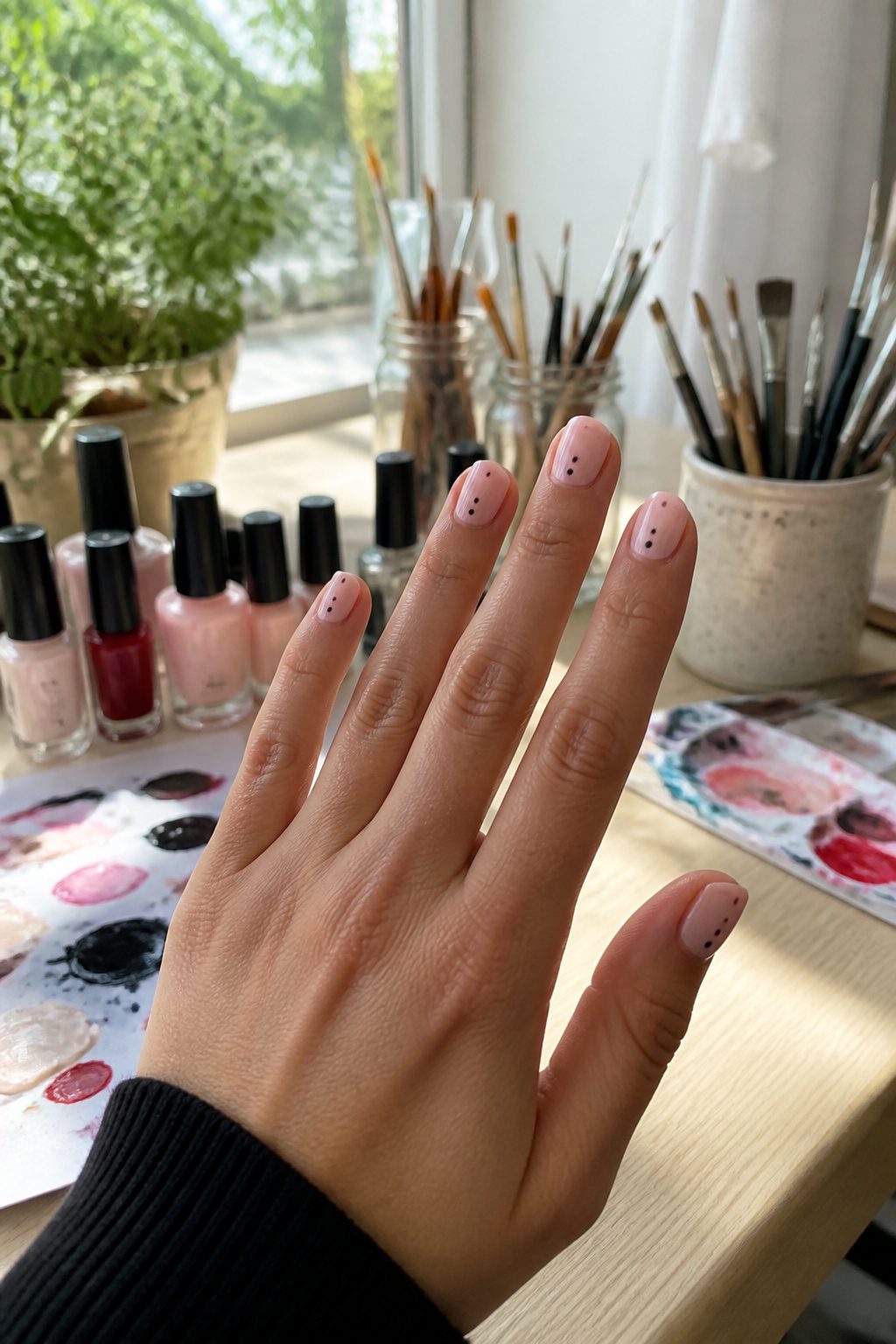
Polka dots landed on my radar last summer when the manicure suddenly appeared everywhere, and the appeal for short nails is simple: the pattern reads as playful without demanding much surface area. The trick is keeping the dots small and sparse, because a few oversized circles will crowd a narrow nail and emphasize its width rather than its length. A toothpick or a small dotting tool gives enough control to place each dot deliberately, and spacing them irregularly, maybe three near the cuticle and one off-center toward the tip, keeps the look from turning into a uniform sheet that would flatten the nail visually. Manicurists who work with shorter lengths tend to steer clients away from anything that draws a thick horizontal line, so a vertical scatter of tiny dots respects that rule while still feeling decorative. Sheer or nude bases help the design float rather than sit heavy, though two contrasting opaque colors can work if the dots stay pin-sized. The shape underneath matters too; a squoval filing, that square base with softened corners, gives the cleanest stage for dot placement and keeps the nail from looking stubby. Matte finishes on short nails need some dimension to avoid looking flat, so a glossy top coat over the dots usually wins.
3. Florals
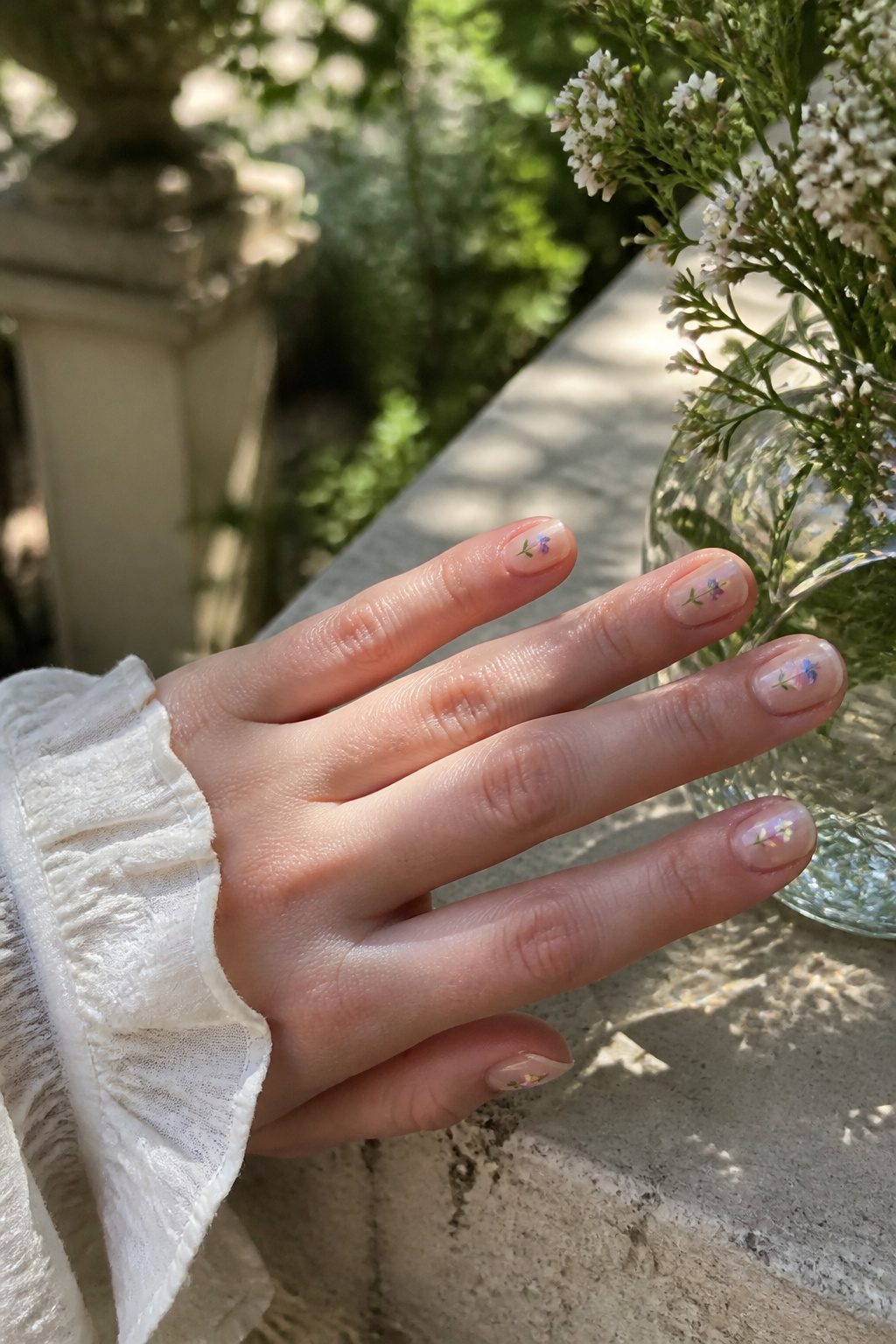
Floral designs on short nails live or die by scale. A single stretched rose across the whole nail bed reads cramped and muddy; three or four tiny buds spaced apart with breathing room between them reads intentional. The nail artist Tom Bachik told Vogue he doesn’t let nail shape determine his designs, which matters here because short nails demand that same flexibility from the wearer: you adapt the flower, not the canvas.
"Fun designs aren’t just for long talons."
— Vogue
That means painterly, loose petals work fine if you keep them small and let the base color show through as background. Dense garden scenes with stems, leaves, and insects need the visual real estate of longer nails; on short ones they tip into cluttered fast. The cleanest short-nail floral I’ve worn is a single accent nail with one five-petal bloom, the rest in a sheer wash. The others read as negative space, which makes the one flower feel like a choice rather than a compromise.
4. Stripes
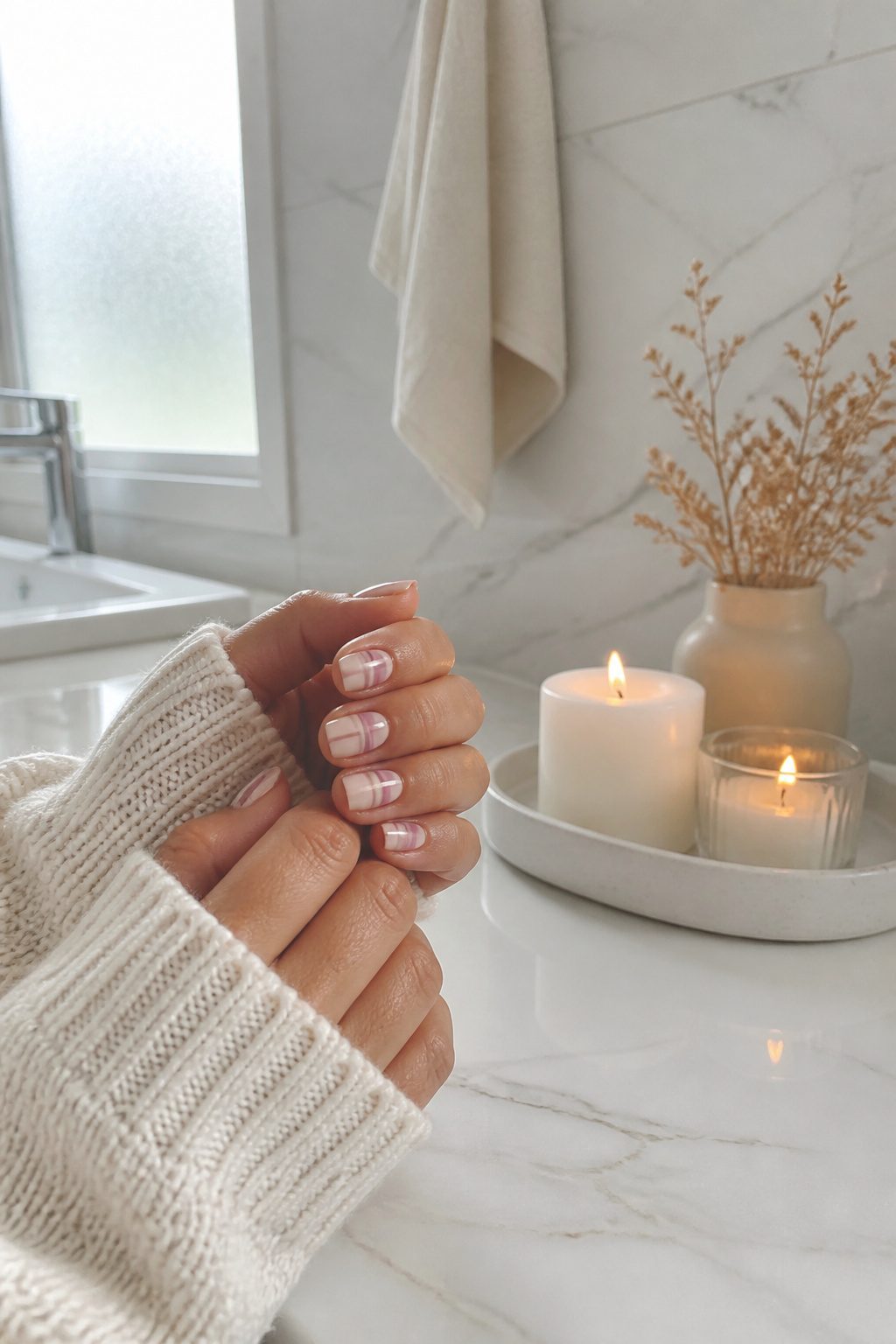
Vertical stripes pull the eye from cuticle to tip, which is exactly what short nails need to look like they extend past the fingertip. A detail brush gives the cleanest line, though tape strips work if your hand is less steady. Two to three stripes per nail, placed slightly off-center, keeps the look from turning into a barcode.
Color choice matters more than the stripe itself. A deep navy or forest green against a nude base adds length without shouting for attention; black on beige reads classic, but the contrast can feel harsh in daylight. Softer pairings, like mauve on pale pink, give the same lengthening effect for someone who does not want their nails to be the first thing noticed.
Diagonal placement does something similar with a little more movement. A single stripe running from one corner at the cuticle to the opposite free edge breaks up the nail’s width the same way vertical lines do, but the angle feels less office, more weekend. The same rule holds: one tone should stay close to your skin color, the other can wander darker.
What to skip is as useful as what to try. Horizontal stripes emphasize width on short nails, which is the opposite of the goal, and matte finishes without a glossy contour or outline flatten everything into a shorter-looking shape. Gloss over the stripe, or at least a thin top coat along its edges, keeps the dimension that makes the elongation work.
5. Mix and Match
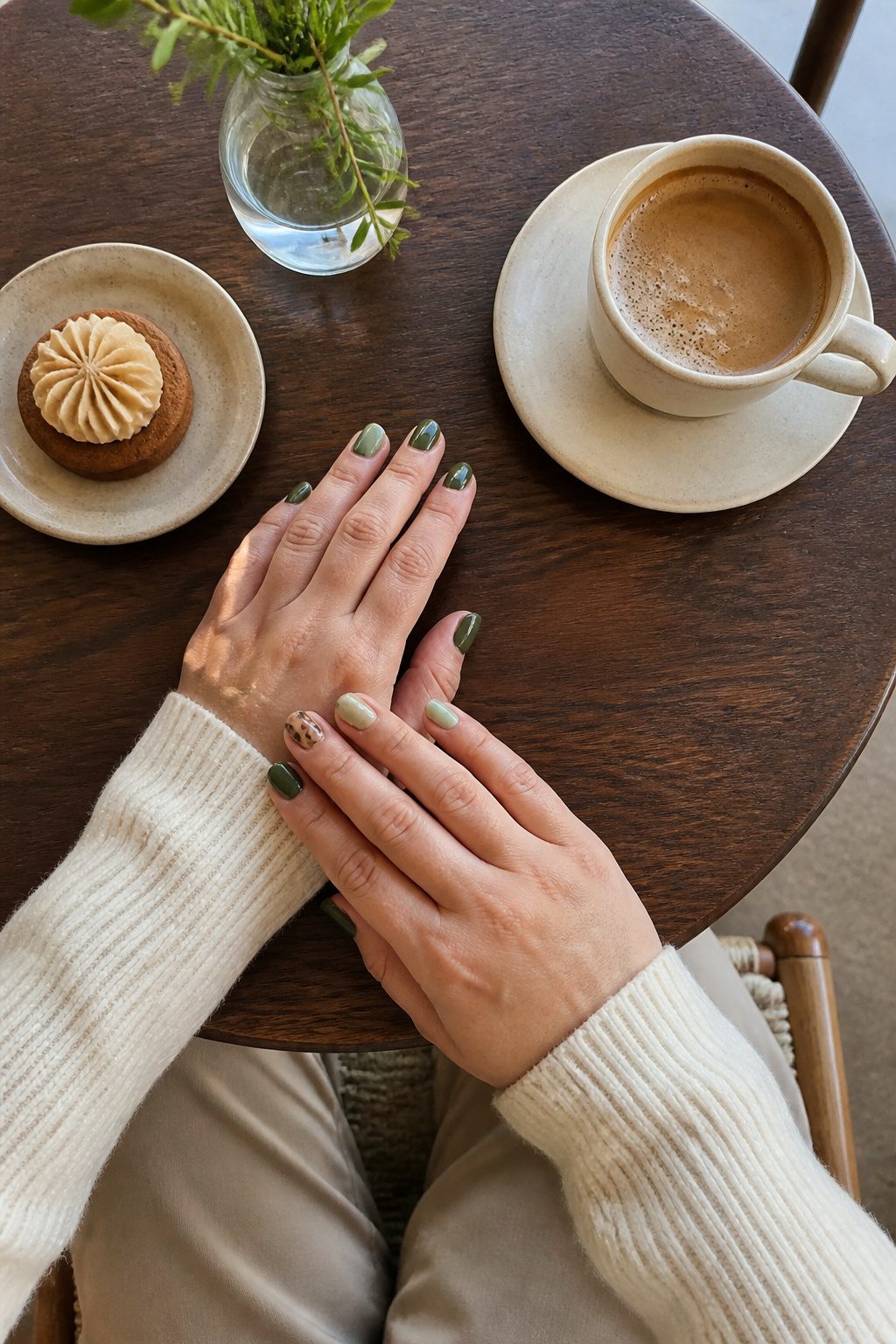
Mix-and-match manicures assign a different design to each nail, which sounds like chaos on a small canvas but reads as intentional when the colors stay in conversation. Pick one base shade as your anchor, then build the rest from that hue or its direct contrast; this keeps the eye moving without fragmenting the hand. On short nails specifically, the squoval shape gives you the cleanest stage for the variation, since the slight rounding at the corners softens the visual noise while the squared base still reads as deliberate structure.
The balance I keep coming back to runs block color against fine detail, two nails of solid pigment against three with line work or micro-gems. If every nail shouts, the short length collapses under the pressure, but alternating quiet and loud lets each design register in its own moment. Limit the palette to two colors plus a neutral, and even your boldest mismatched thumb still feels pulled from the same story.
6. Gem Nails
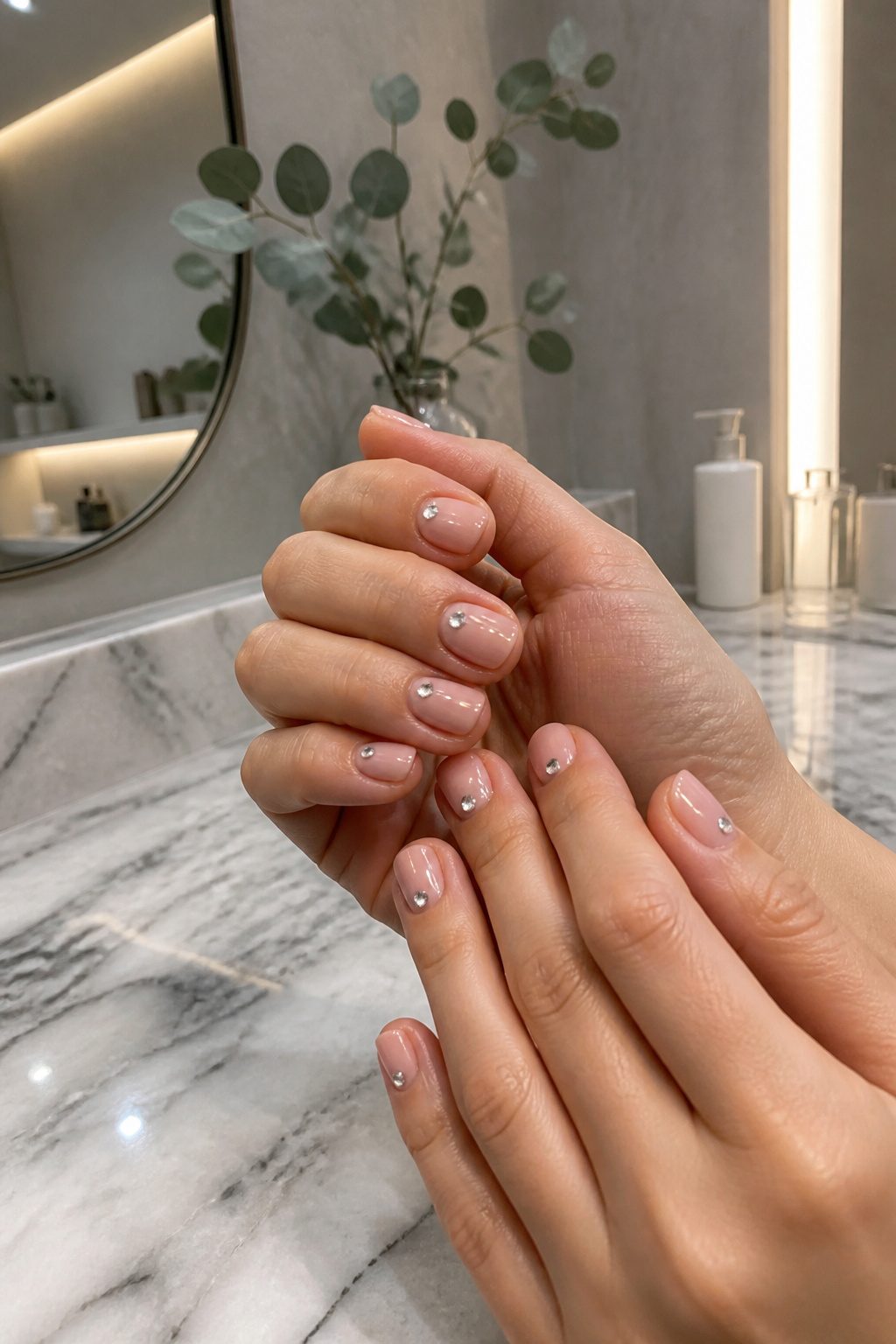
Gem accents on short nails need to stay under 3 mm to keep from catching on hair or fabric and to avoid looking like they’re wearing the finger instead of decorating it. The plate simply doesn’t have the real estate for statement pieces.
Placement matters more than size. One gem set flush near the cuticle, or a pair framing the center of the nail, reads as deliberate. Scatter them and the eye loses the design to clutter. Encapsulation is what keeps them there: a drop of gel or polish underneath, then two layers of top coat over the top. Skip the encapsulation and the edge of the stone lifts within days, usually on the hand you use most.
I tend toward one nail per hand, two at most. Kylie Jenner and Sabrina Carpenter have worn fuller versions, but their sets are maintained daily. For regular wear, the restraint is what makes it look expensive rather than accidental. A nude or pale pink base underneath keeps the focus on the stone itself, and the chrome or pearl finish reads neater on short lengths than on long ones, where the effect turns excessive.
The real test is the week after application. A gem that snags while you’re pulling on a sweater or typing was too big or too proud of the surface. File the edge of the top coat if you feel it catch, or remove the stone and top coat the bare spot smooth.
7. Lunula Art
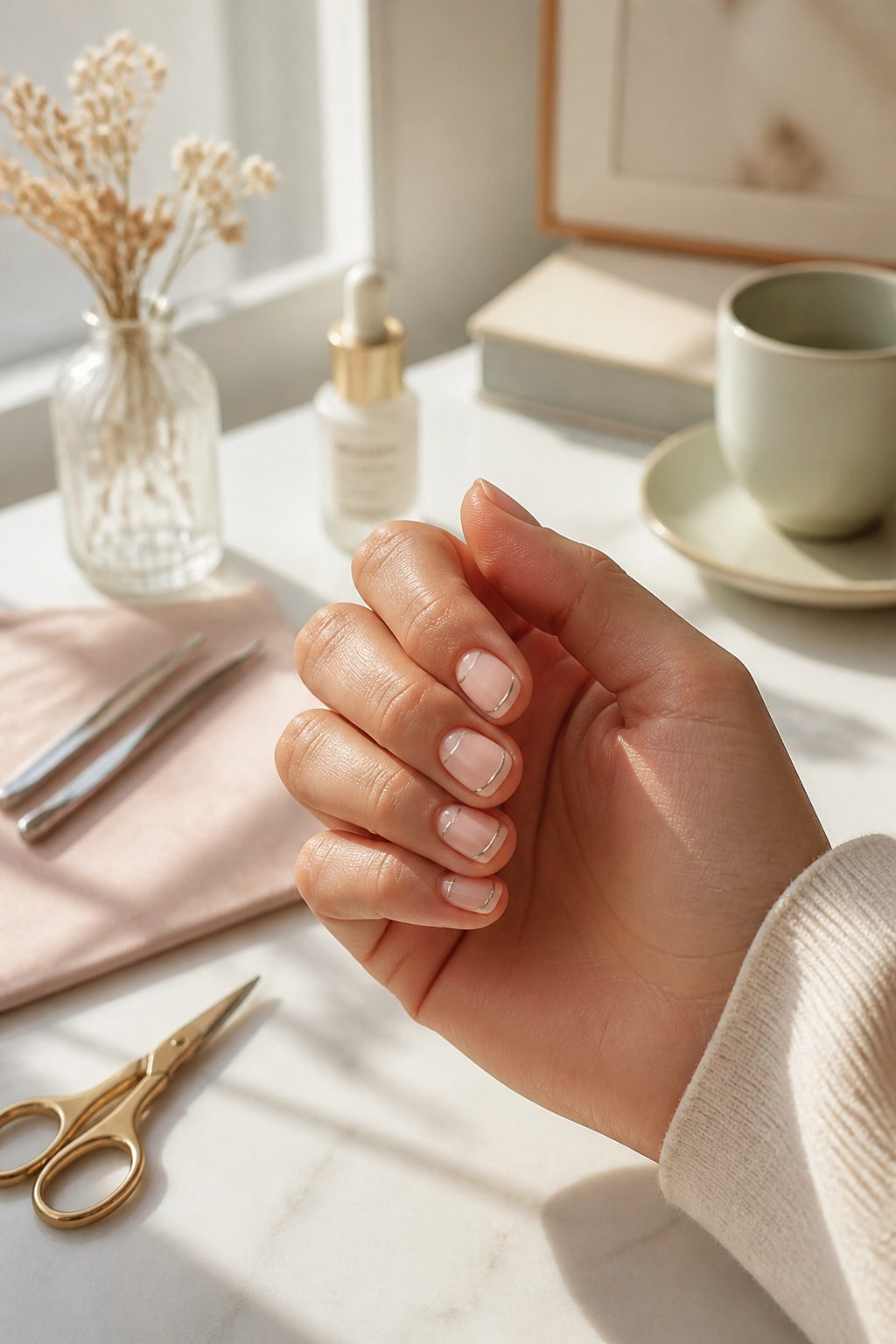
The lunula, that pale half-moon at the base of each nail, becomes the star when you want short nails to read longer than they are. Drawing the eye upward to the nail bed creates the illusion of extra length without adding a millimeter of actual growth. Two ways to play this: outline the lunula with a fine brush in a contrasting shade, or fill it in with color and leave the rest bare for a negative-space effect. Reflective glitters catch light right where you want attention, while pastels keep the look subtle enough for everyday wear. A filled-in lunula in soft pink against a nude nail reads polished and intentional; a metallic outline feels sharper for evening. The shape underneath matters too. Squoval filing, with its straight edge and gently rounded corners, supports this trick best by keeping the nail base looking elongated rather than boxed in. Skip the almond shape here; it needs more length to register as elegant rather than pointy on a short canvas.
8. Fisherman Core Nails
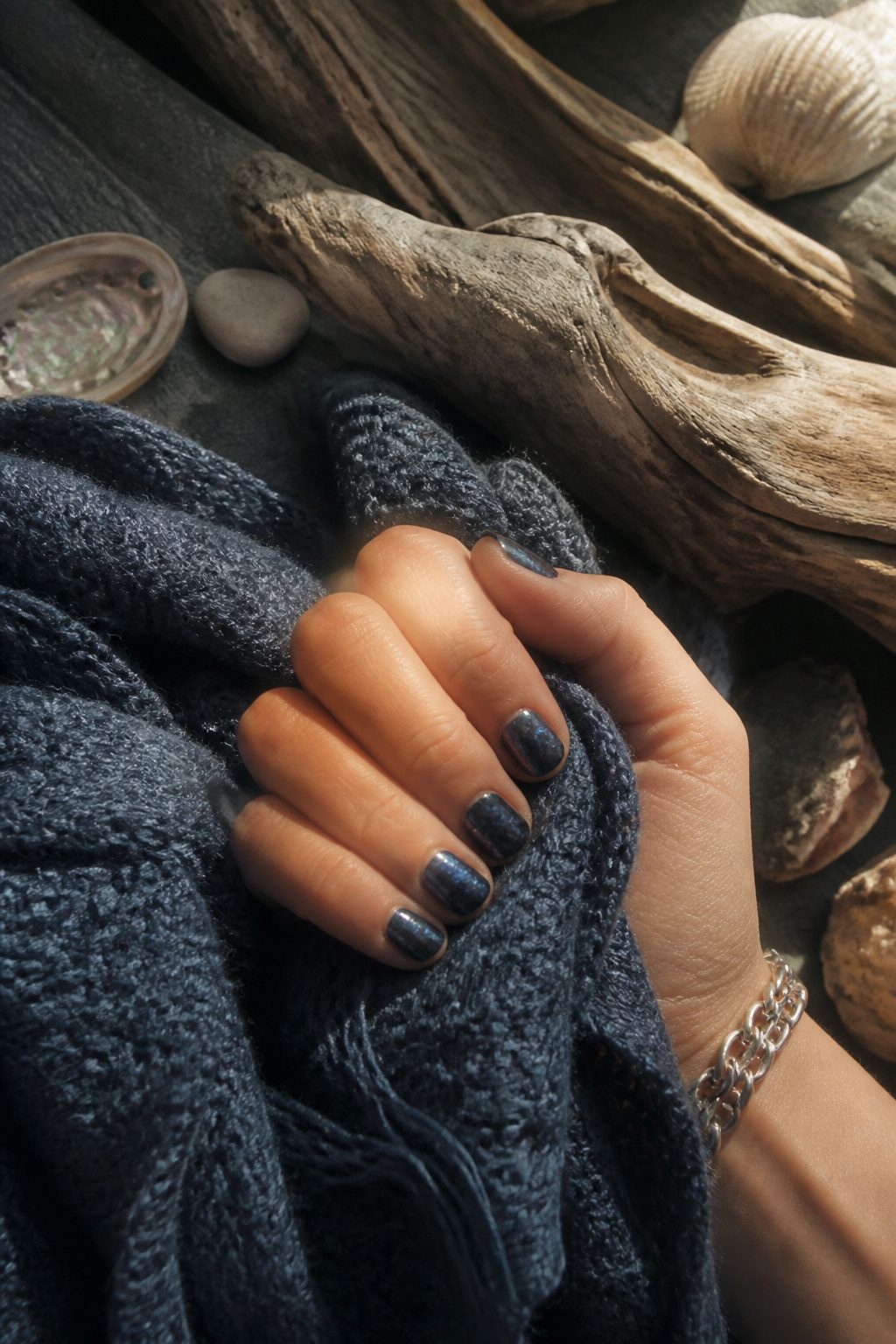
The fisherman core aesthetic landed on short nails by way of muted, utilitarian colors that read more dockside than decorative. Think weathered rope, faded navy, and the dull silver of old hardware rather than anything bright or beachy. Nail artist Hang Nguyen, who works under the name the Hang Edit, pointed out that the fish shape itself maps neatly onto a natural short nail; the curve of the body follows the curve of the fingertip without fighting for space. She uses magnetic polish and chrome to replicate iridescent scales, which keeps the detail small enough not to overwhelm a shorter canvas. The Secret Lab experts recommend limiting any 3D elements to one or two tiny pearls placed near the cuticle or in a thin linear detail, never scattered across the whole nail. For short nails specifically, matte finishes need a contour or some shine added back in so the nail doesn’t lose dimension and look flatter than it is. Horizontal lines that stretch side to side will visually shorten the nail further, so the graphic elements here stay vertical or asymmetrical: a single thin stripe, a small abstract shape, a dot placed off-center. The overall effect is practical, almost workwear, which is exactly the point.
9. Evil Eyes
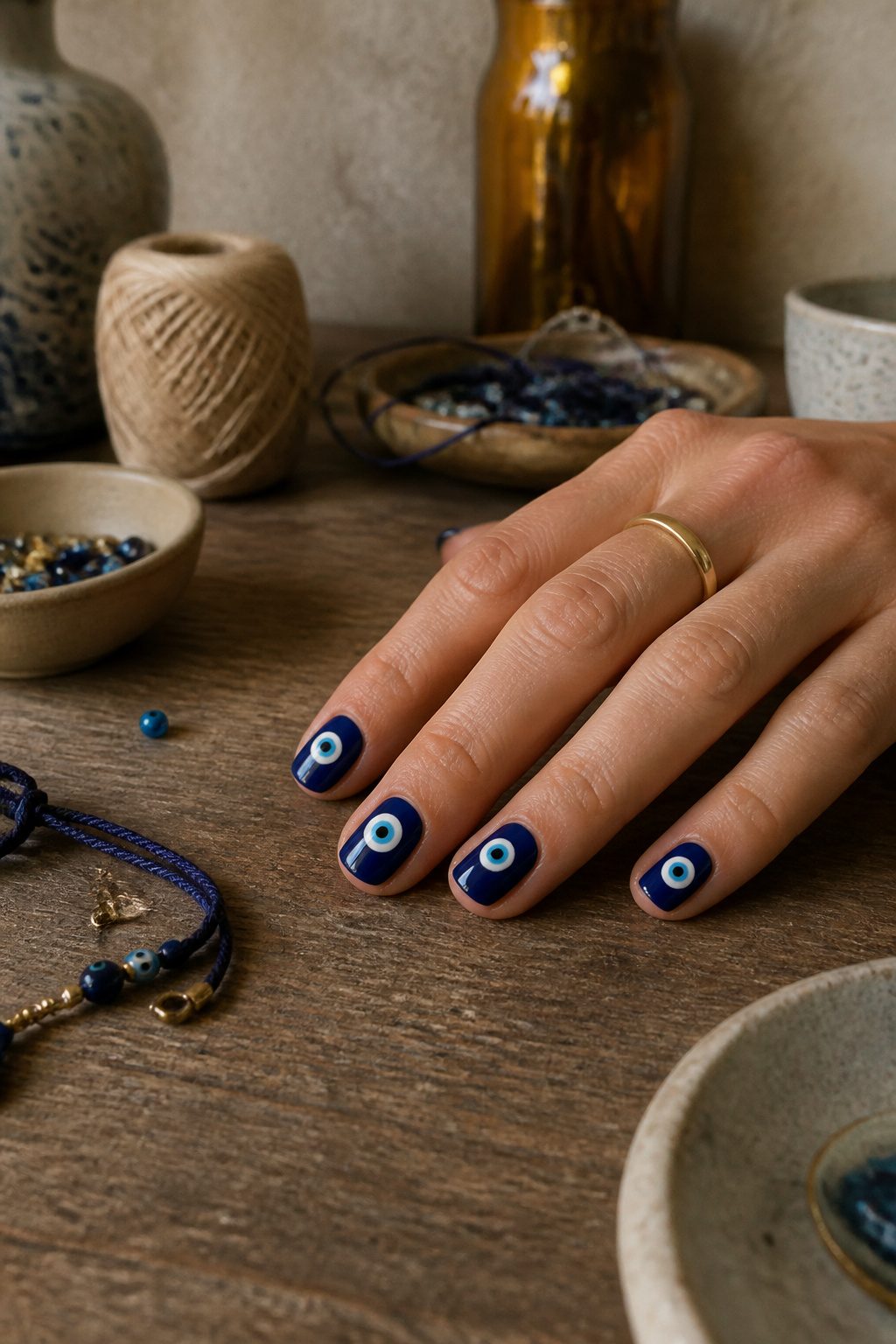
Evil eye motifs shrink surprisingly well onto short nails because the symbol’s power is in its structure, not its size. The concentric rings of blue, white, and black still read instantly at 3–4 millimeters across, which is about what a pinky nail allows. What falls apart is the detail work: the tiny lash lines sketched around commercial evil eye stickers get muddy when compressed, so the simplified version wins on short nails—a dark pupil, one white ring, and one blue ring, no more.
Color placement matters more than color count. A navy or cobalt base with the eye painted in white and black pops against most skin tones and keeps the symbol recognizable from arm’s length. Pastel backgrounds, which look soft on long almond shapes, tend to swallow the detail on a smaller canvas; the contrast has to do the heavy lifting.
The dotting-tool method from home manicure kits handles the scale issue cleanly. A larger dot creates the blue base, a smaller dot drops the white ring inside it, and the smallest tool or a toothpick finishes the black pupil. Letting each layer dry before the next prevents the rings from bleeding together, which is the mistake that turns a deliberate symbol into an accidental blob. On a squoval shape, which flatters short nails without the coarseness a sheer square can add, the eye sits centered near the cuticle or scattered as a single accent nail among solids.
10. Micro Fruit
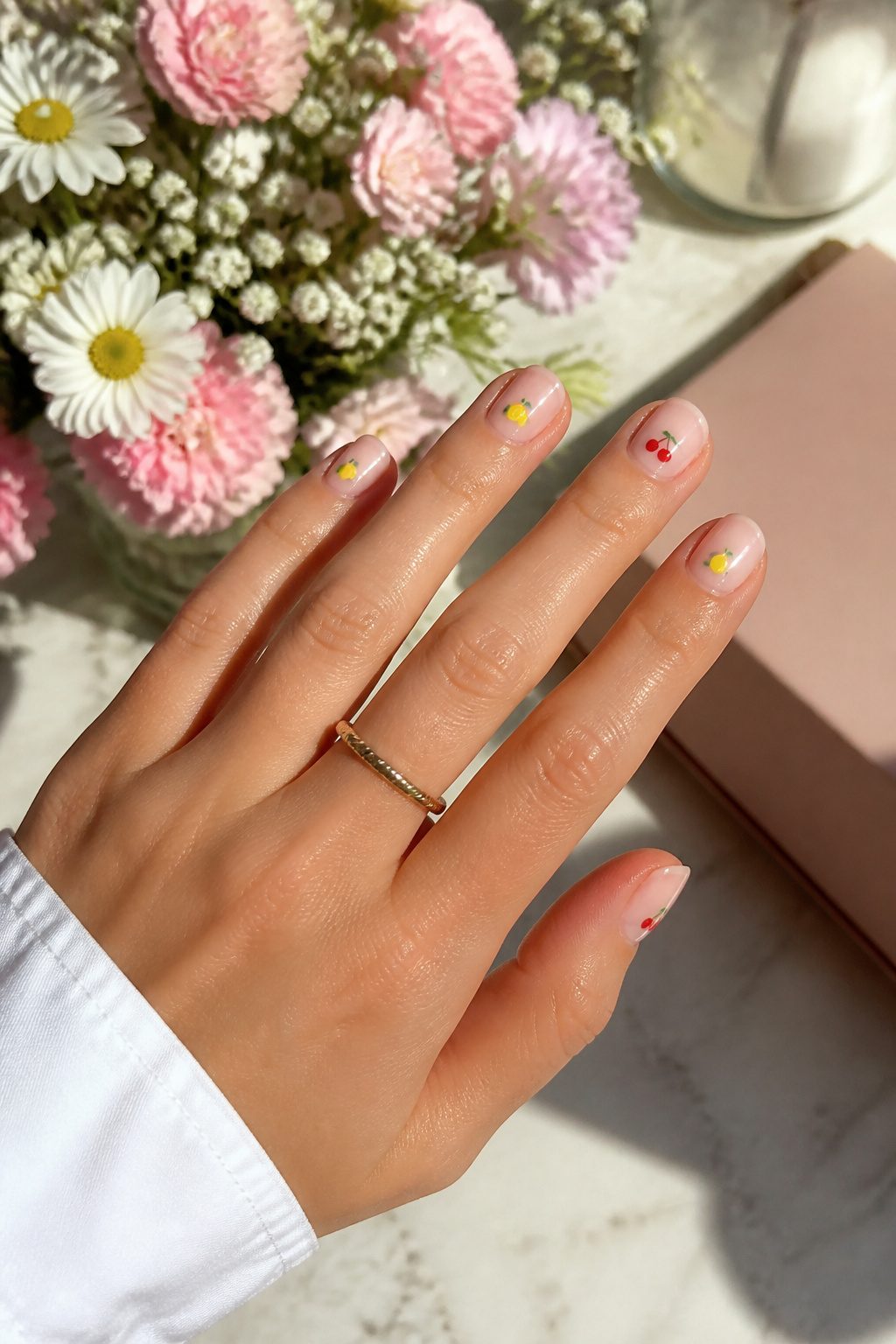
Strawberries, cherries, and lemons scaled down to pinhead size landed on short nails last summer and stuck around for good reason. The miniature scale suits limited nail space because one tiny illustration near the cuticle or centered on the nail reads as deliberate, not crowded. A neutral base color keeps the look understated; the fruit becomes a accent rather than a competition for attention. Manicurists who work with shorter lengths recommend this kind of strategic placement, keeping designs from stretching horizontally and visually shortening the nail further. I tried a pale pink base with a single lemon slice on my ring finger last month, and the nail still looked longer than when I had attempted a stripe across the full width. The key is restraint: one fruit per nail, two at most, and never large enough to wrap the edges. Small pearls work the same way when limited to one or two at key points, but fruit illustration carries more personality without the 3D height that can catch on pockets.
11. Cat-Eye
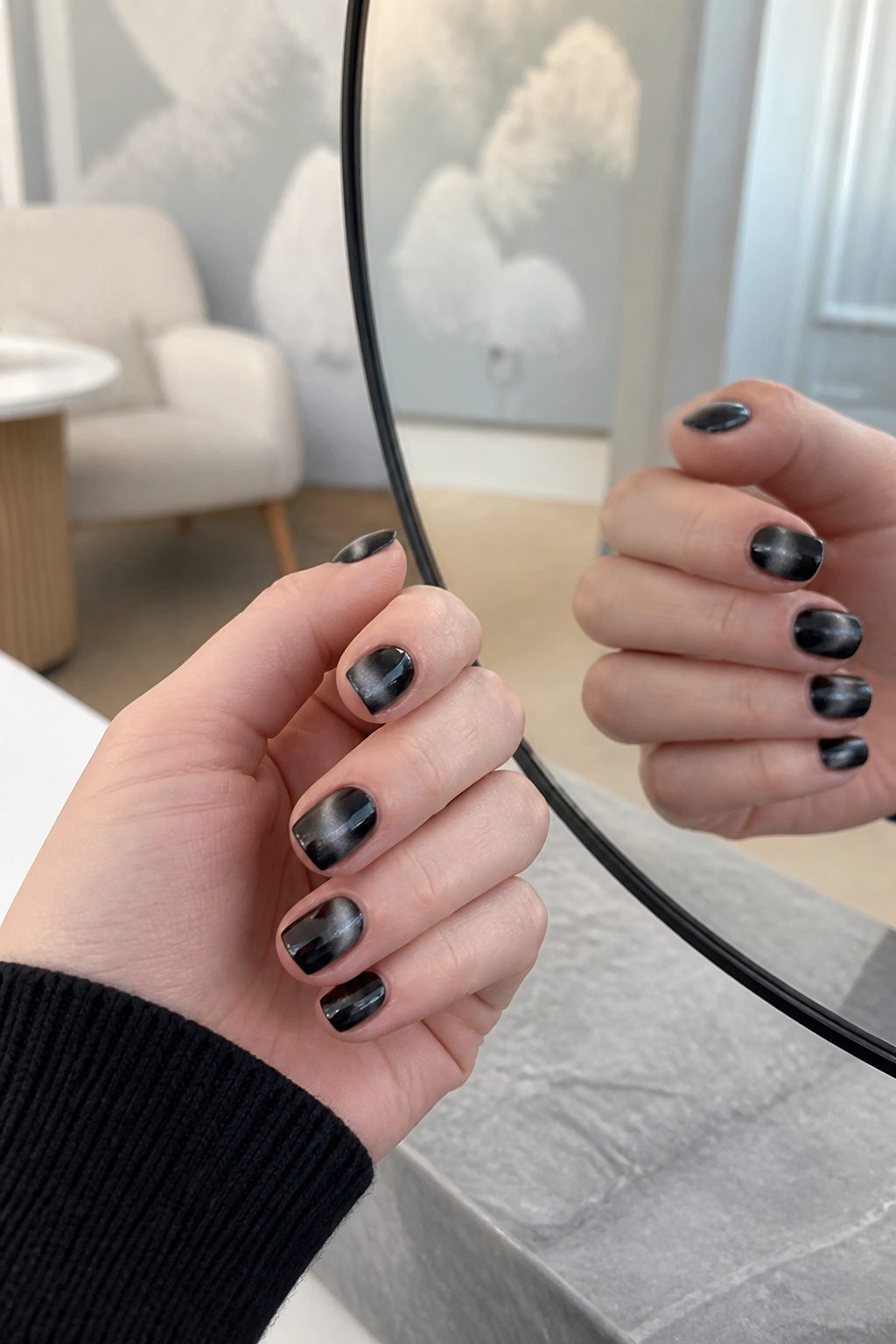
The cat-eye magnetic polish effect works better on short nails than most people expect. A narrow band of metallic shimmer runs down the center of each nail, and that vertical line does something useful: it pulls the eye lengthwise, which makes the nail itself seem longer than it is. On a short nail, the stripe sits closer to the edges, so the contrast between the reflective center and the darker base color reads as deliberate rather than cramped.
You build it by brushing on the magnetic polish, holding the magnet close for ten to fifteen seconds while the surface is still wet, then curing under the lamp. The magnet shifts the metallic particles into that slim arc. The stripe should sit slightly off-center toward the free edge, not dead middle, or the nail looks split rather than lengthened.
I’ve seen this fail when the magnet is too far from the nail, or when someone overworks the polish trying to get a wider flash. The effect wants restraint. A thin, clean line catches light as you move your hands; a broad smear just looks muddy. Dark bases, deep navy or black, make the contrast sharpest. Lighter colors soften the effect into something that barely registers from across a table. For short nails, sharp contrast is the whole point.
12. Seashells
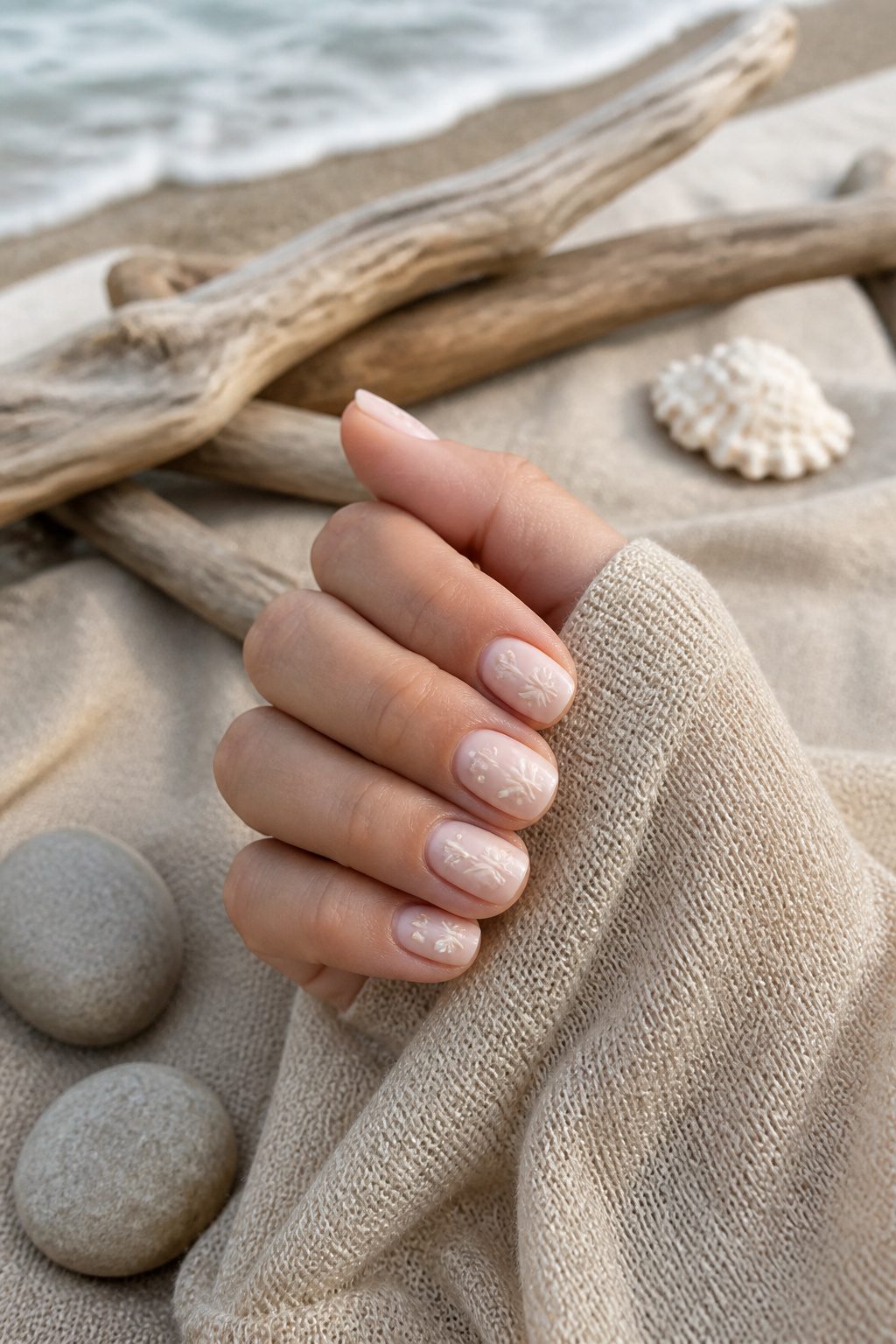
Seashell nails work especially well on short nails because the curved, organic shapes echo the natural arc of the nail bed itself. The rounded edges of a shell motif soften the square-with-rounded-corners filing that flatters shorter lengths, avoiding the coarser look a sheer square can give on a compact nail. Iridescent finishes pull this off without demanding precision: a wash of pearlescent polish or a swipe of chrome powder catches light like the inside of an abalone shell, and the effect forgives minor imperfections in your line work. Neutral base tones keep the look from turning costume-y; think sand, blush, or the palest lavender rather than literal white. A fine nail art brush helps lay down the ridges and whorls, but even a soft sponge dabbed with two shifting polishes can suggest that wet-shell gleam. The key is letting the natural curve do some of the work for you, rather than fighting it with geometry that needs length to read properly.
13. Nude Nail Art
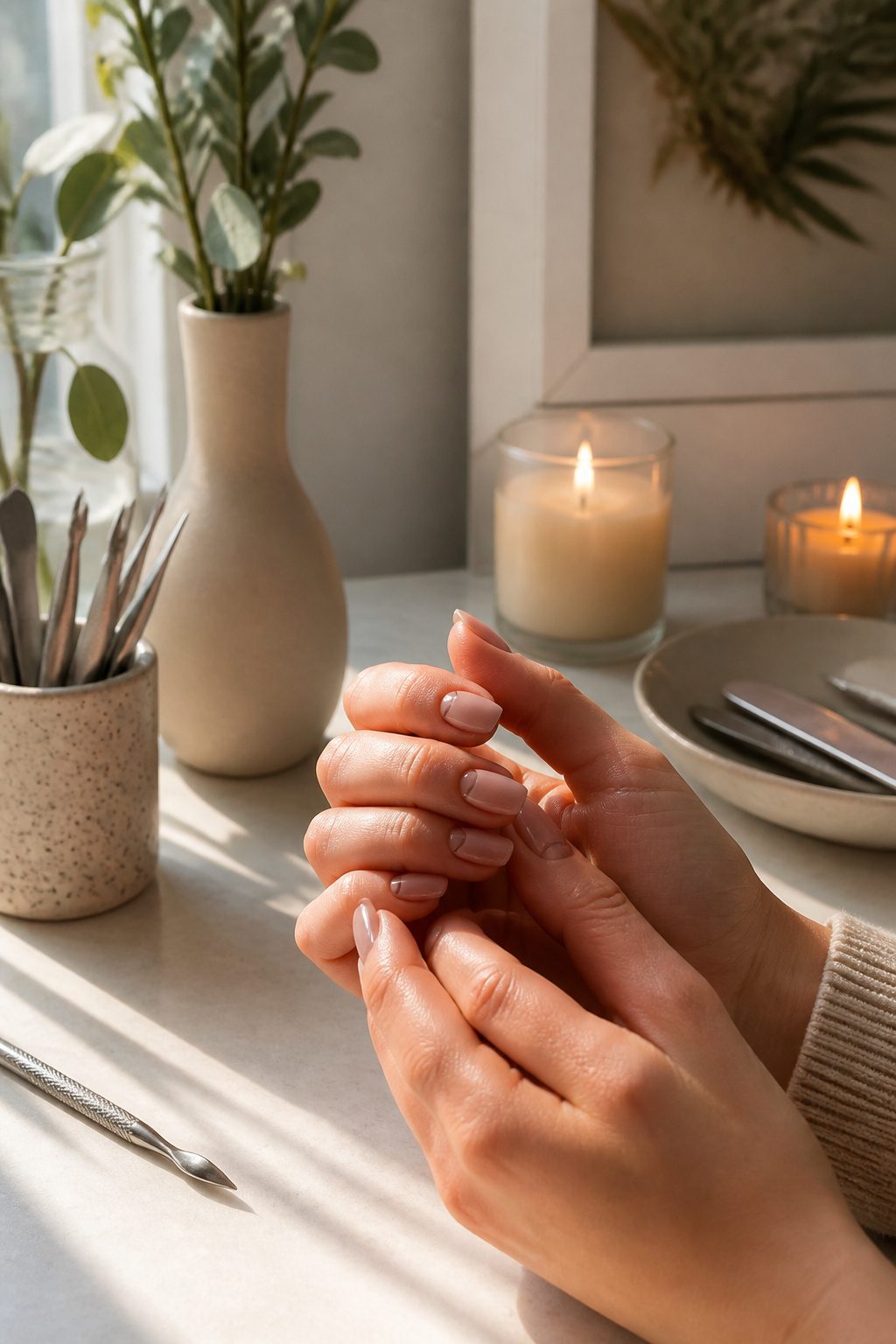
Nude and translucent pink tones work on short nails because they echo the color of the skin itself, which visually extends the finger line rather than interrupting it. Manicurists call this the lengthening effect, and it pairs with that understated "clean and healthy nails" look that reads polished without trying hard.
The risk with nude is flatness, especially if the finish is matte, which can make a short nail look dimensionless. Glossy topcoats fix this; they catch light and give the nail a subtle lift. For art that does not break the elongating illusion, keep additions tonal. A translucent pink base with a slightly deeper pink half-moon at the lunula, outlined or filled, draws the eye upward without chopping the nail into competing blocks. Reflective glitters or pastel accents in the same family work the same way.
One understated move: a chrome gradient over a nude or pale pink base. On shorter nails, the chrome stays neat rather than excessive, and the neutral ground keeps the lengthening effect intact. Small pearls placed sparingly, near the cuticle or in a single linear detail, add texture without bulk. The rule is restraint: one or two nails, one or two elements, all within a shade or two of the base tone.
14. Japanese Blooming Gel
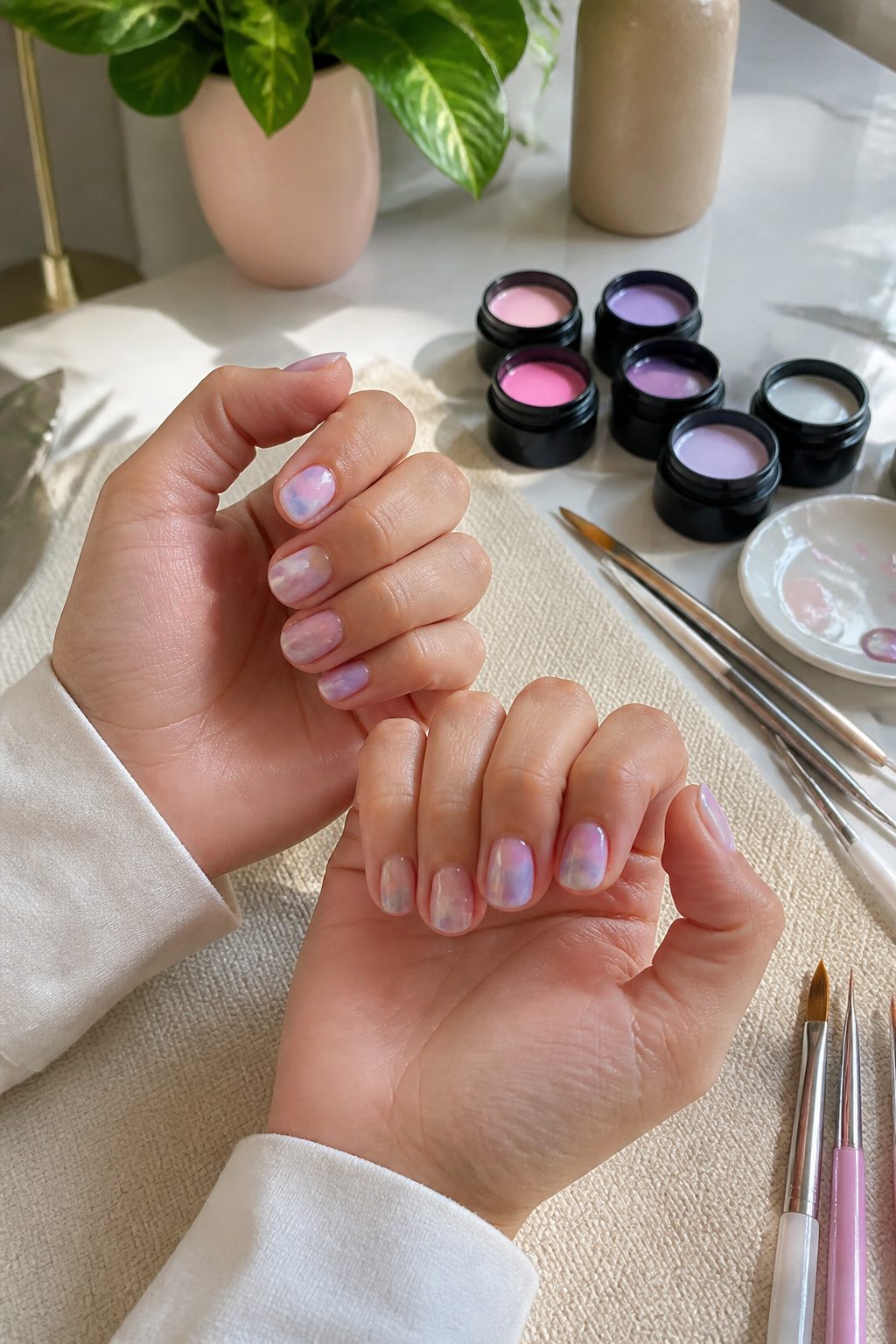
Japanese blooming gel works differently than a standard manicure where every line stays exactly where you place it. The pigment spreads on its own, feathering outward to create soft, fluid edges that look almost alive on the nail. This organic movement is what makes the technique so forgiving on shorter beds.
On short nails, hard boundaries and sharp geometry can feel cramped or visually chop the surface. The feathered, watercolor-like edges of blooming gel do the opposite. They blur the perimeter, which gives the illusion of a little more length without actually needing it. The color pool at center and fade at edges draws the eye inward rather than tracing a hard stop.
Natalia Mercedes, who founded Manhattan’s Sad Girl Nails Studio, described the effect as introducing movement rather than control. That lines up with what short-nail wearers need: designs that don’t fight the limited canvas but work with it. Soft gradients, abstract color clouds, and tonal blooms all sit comfortably without the horizontal emphasis that manicurists warn can visually shorten a nail further.
A single shade feathered into clear gel gives a stained-glass subtlety. Layering two opaques creates more drama while still keeping the edges gentle. Either way, the pigment does the placement work for you, which means less precision required and less chance of a design that overruns the small space.
15. Glossy Berry
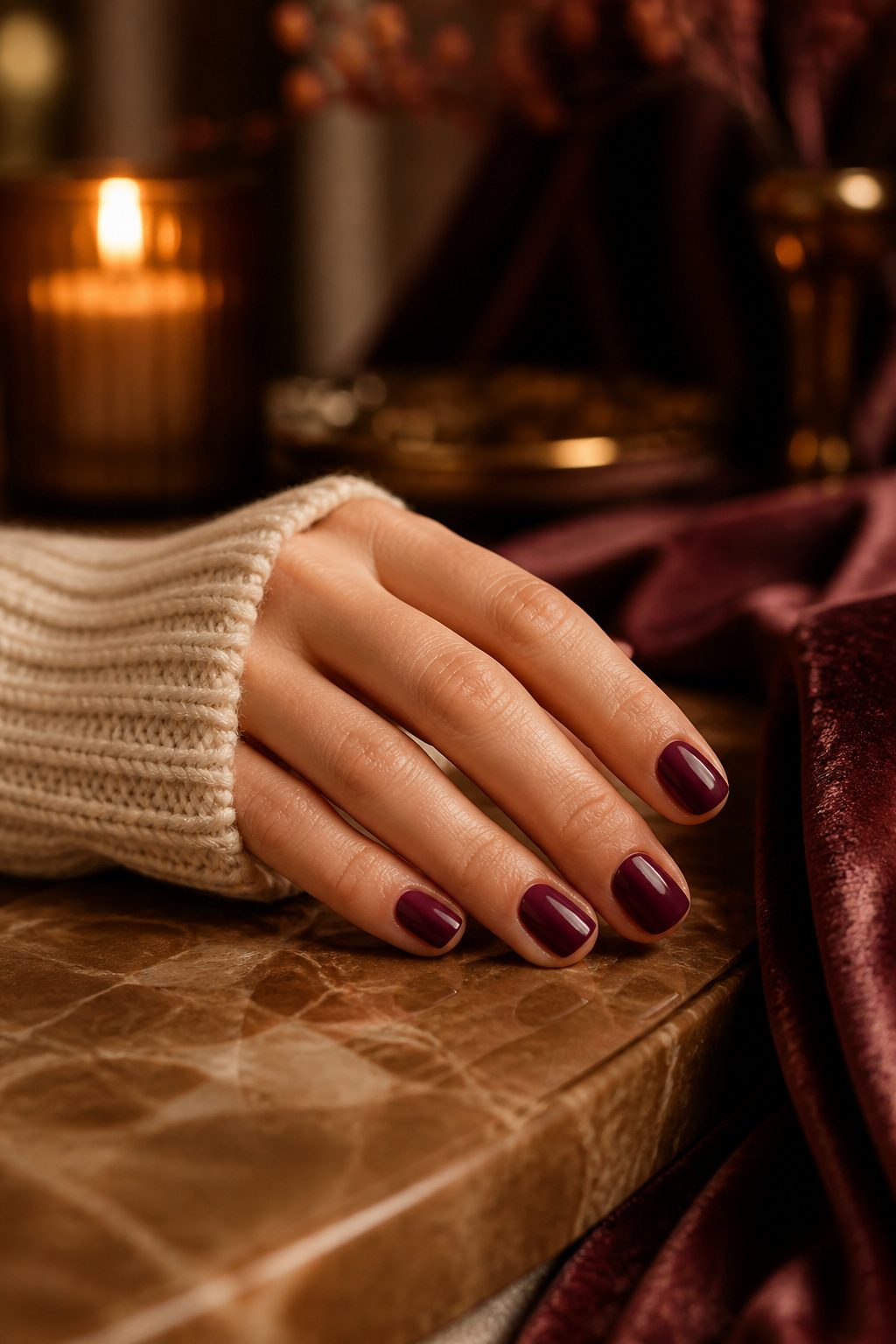
A glossy berry finish catches light across the whole nail plate, and on short nails that reflection does real work. The shine creates subtle highlights where a matte surface would read as flat, so the eye registers more nail than is actually there. Burgundy and deep wine tones do this especially well on shorter lengths because the color itself is dense enough to look intentional rather than apologetic.
The contrast against skin matters more than the exact shade. A berry with enough red in it reads clean against most undertones, while something too purple or too brown can sit heavy on a small surface. The manicurists who built this rule were thinking about exactly that visual lengthening effect, not just color theory in the abstract.
A glossy topcoat is non-negotiable here. The same burgundy that looks sophisticated with shine turns almost chalky under matte, and matte finishes on short nails tend to emphasize every irregularity in the nail bed rather than smoothing it over. The gloss does the smoothing for you, plus it bounces light back toward the viewer in a way that extends the visible edge of the nail.
Two coats of color plus topcoat is the standard build. Any more and you risk thickness that short nails can’t carry without looking like small domes. The payoff is a manicure that reads expensive without requiring length, which is the whole point of choosing this direction.
16. Black Scalloped
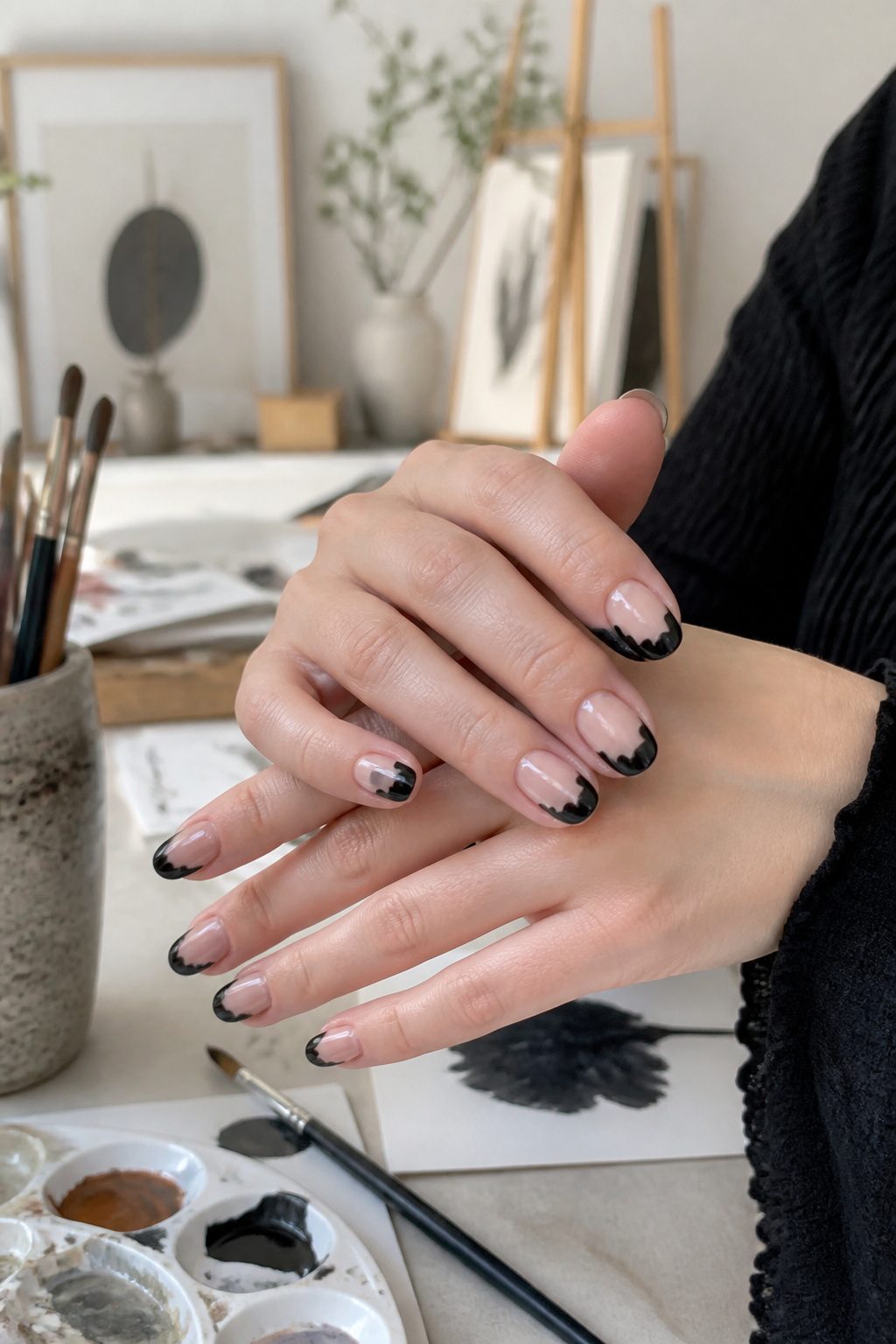
A scalloped free edge drawn in black polish turns the nail into something closer to a paper cutout or vintage trim than a standard manicure. The curve repeats every few millimeters along the tip, softening the blunt line where short nails often end abruptly. On a longer nail the same motif might read as costume-y; compressed onto a small canvas it stays graphic and deliberate. I think the contrast matters more than the shape itself. A matte nude or sheer pink base lets the black line do the work without competing, though I have seen it reversed, with the scallops cut out of black negative space against a bare nail. The drawing is finicky. A detail brush and a steady hand, or a set of curved vinyl guides pressed along the tip, will keep the waves even; freehanding it tends to wobble after the second nail. Start with the center scallop and work outward so the pattern stays symmetrical even if your spacing drifts slightly. One coat of black looks thin; two gives the edge the weight it needs to read from conversation distance. The whole thing chips faster at the tips than a solid color would, but the repair is localized, just redrawing the curve, not repainting the whole nail.
17. Gold Chrome French Tips
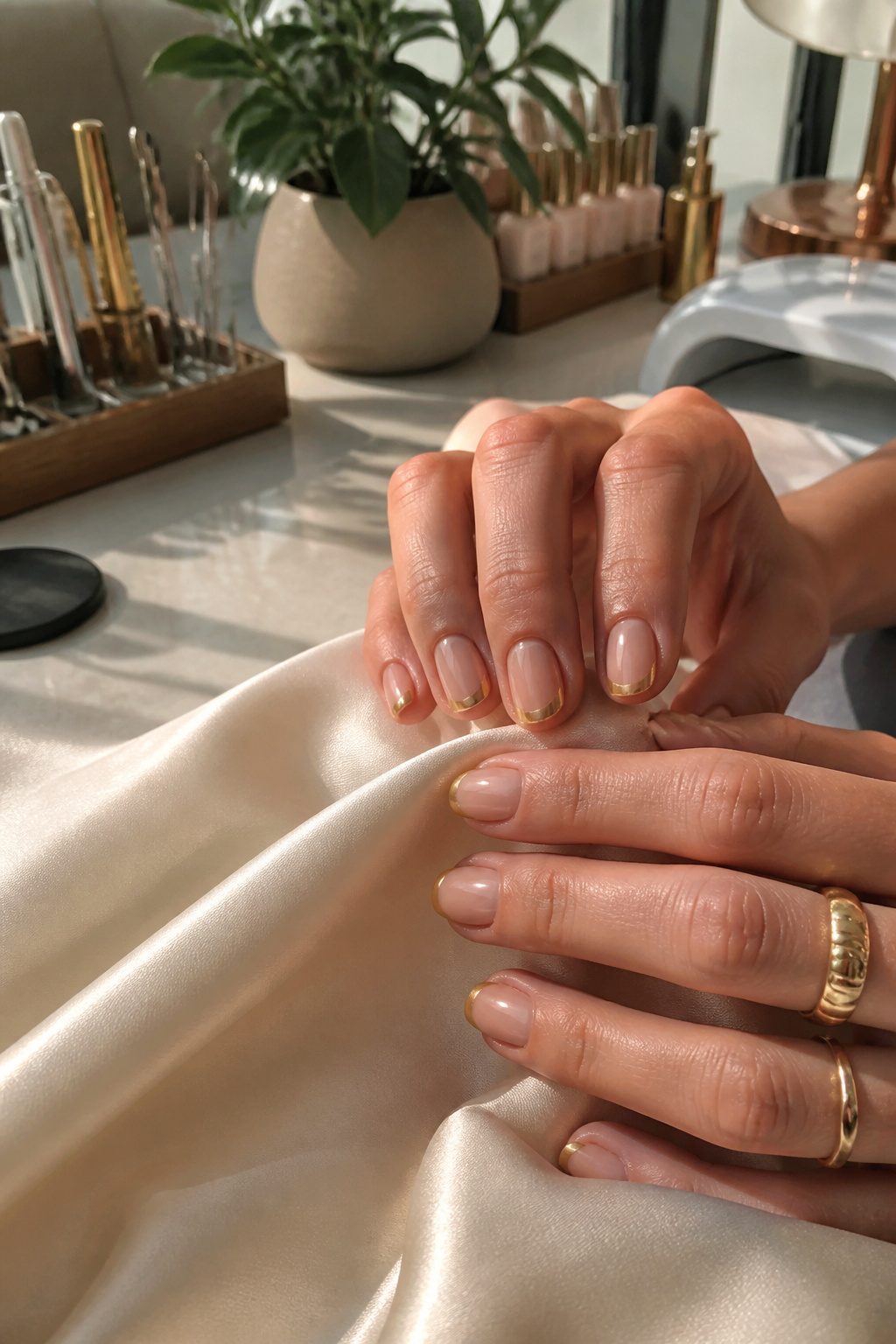
The mirror finish on gold chrome French tips turns a short nail into something that catches light with every gesture. On shorter lengths, that reflection becomes the point, not an afterthought. A classic French keeps its white band matte and polite; chrome powder buffed over a gold base makes the same curve look liquid and expensive.
The shift works because short nails keep the chrome from reading as costume. Too much surface area in metallic gold can tip toward Vegas, but a narrow crescent at the free edge stays controlled. The reflective quality also does practical work on short nails, making the free edge visible and deliberate where bare growth would otherwise disappear into the finger. A soft gold chrome, almost champagne, keeps it wearable for everyday. Brighter true gold reads more evening and, in my view, asks for a specific occasion. Either way, the chrome needs a no-wipe gel top coat sealed with a silicone tool; fingerprints will ruin the finish before you leave the salon if the tech touches it bare-handed.
18. Sparkly Lilac
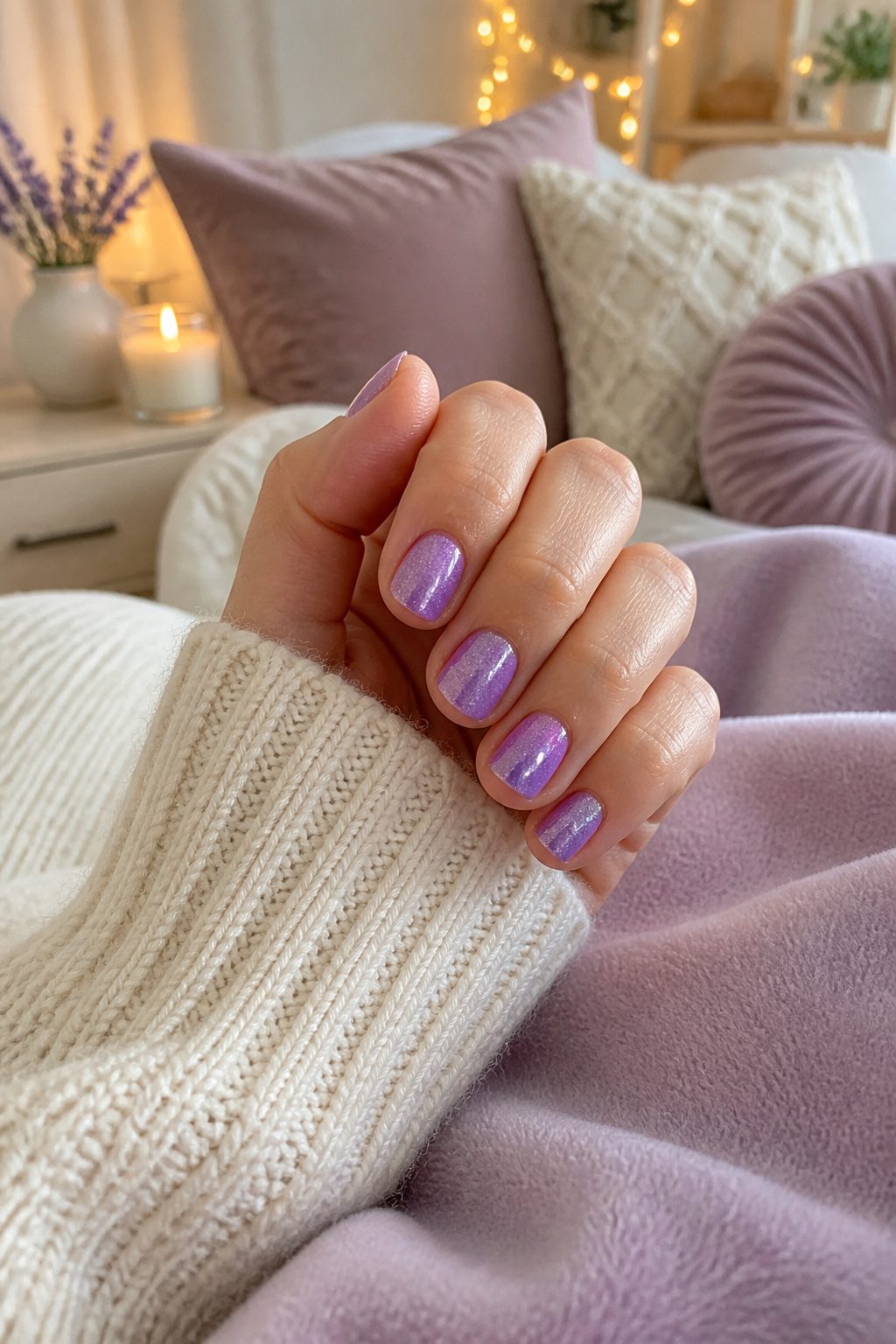
Shimmer in a soft purple base catches light differently on short nails than it does on long ones, and that is exactly why sparkly lilac works better on a clipped nail bed. The particles sit closer to the fingertip, so the reflection stays concentrated and deliberate rather than scattering across too much surface. A dense glitter can read juvenile; a fine, almost dust-like shimmer suspended in translucent lilac reads expensive and calm.
The best versions layer a milky lavender cream with one thin coat of iridescent topcoat, applied only where the nail curves. This places the glow at the highest point, which creates the illusion of a longer nail plate without any actual length required. I have seen this done with a full-coverage sparkle too, but the effect flattens unless the nail has some natural convexity to catch side light.
Maintenance is forgiving. Grow-out on a pale purple is less obvious than on a stark nude or a dark color, and the shimmer masks minor edge chips for several extra days. Reapplication of topcoat every four days keeps the sparkle alive without a full redo.
19. Short Navy Blue Abstract
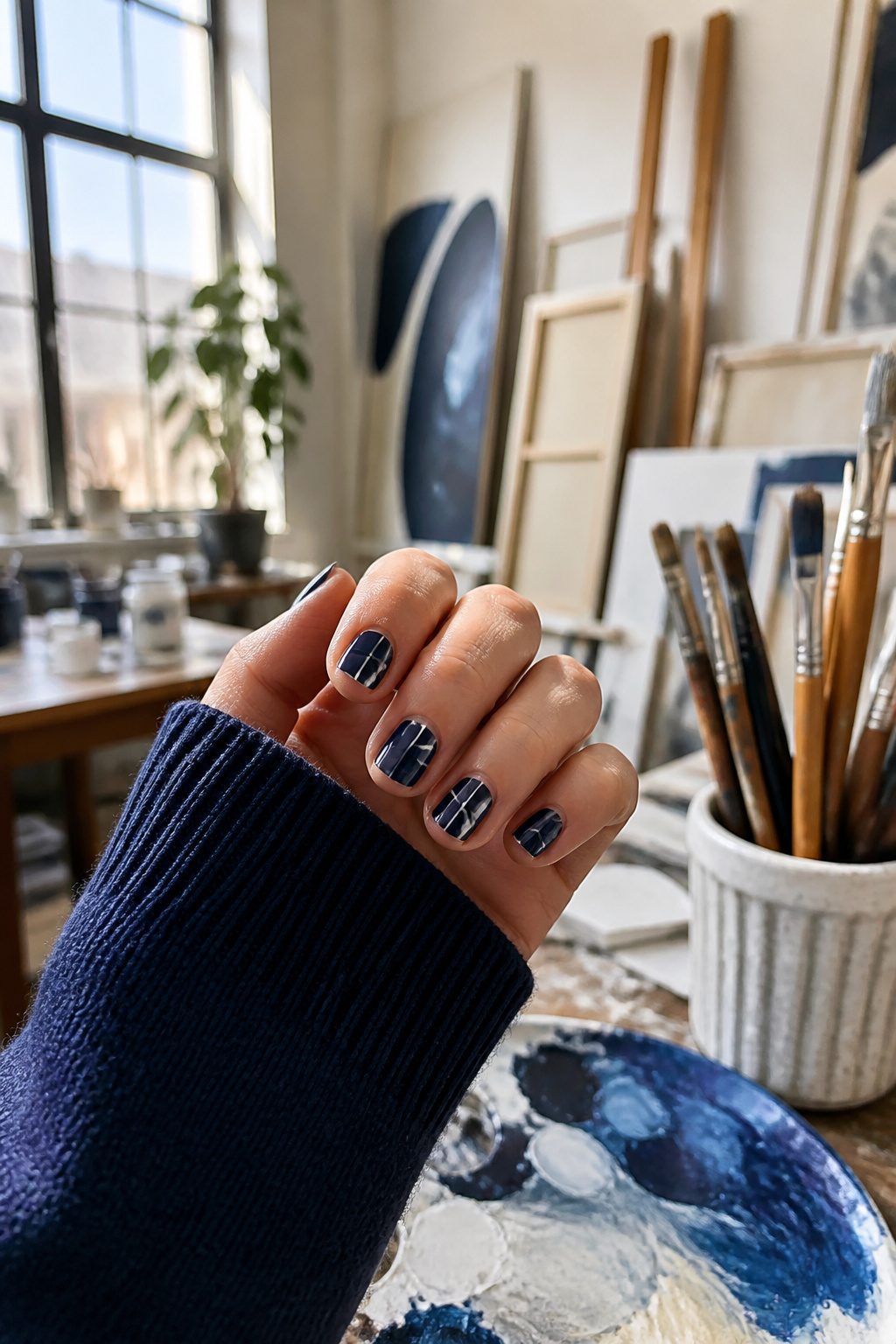
Navy blue on a short nail risks looking like a chipped-off corner of something larger, which is exactly why abstract shapes keep it modern instead of moody. The manicurists in those guides nail this: dark tones create contrast that makes the nail read slimmer and more sophisticated, and the color disguises irregularities in the nail bed that shorter lengths tend to show. The trick is breaking up the surface so the eye travels rather than settling into one heavy block.
Geometric lines, asymmetrical color blocks, or simple dots placed off-center work because they add dimension without emphasizing width. Glossy finishes help here too; they enhance the nail and give it a more flawless look, so the navy catches light differently across each shape. I skip horizontal stripes or anything that runs side to side, since those visually shorten what is already short, and I avoid clustering too many elements on one nail. One clean arc or a trio of irregular dots per nail, done in a slightly lighter blue or even a thin metallic, keeps the whole thing feeling intentional rather than apologetic.
20. Cute White Ducks
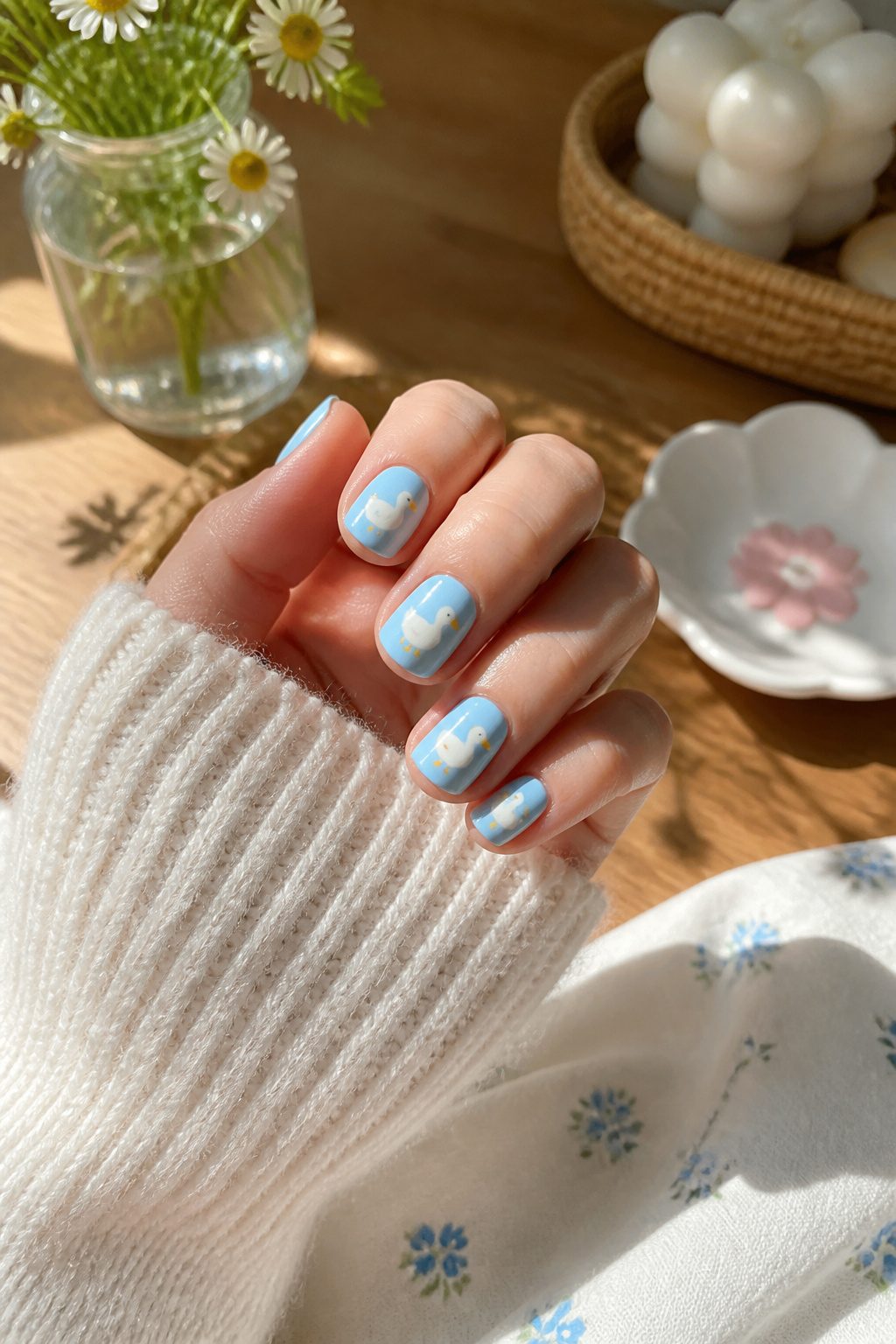
Tiny illustrations only work on short nails if the shape stays readable at a glance, and a white duck silhouette passes that test better than most motifs. The rounded body, short neck, and simple bill reduce to a clean graphic that still reads as "duck" even on a pinky nail no wider than a pea. I have seen this go wrong when people add too much detail: eyes, feather lines, or a little orange foot turn the design into smudged noise once the top coat goes on. The winning versions keep it to two colors, usually a soft pastel base with opaque white for the bird itself.
Placement matters more than you would think. One duck centered on the ring finger, facing toward the thumb, gives the eye a place to land without crowding the other nails. The rest of the hand can stay bare or carry a single stripe in the same pastel. A duck facing the cuticle instead of the tip looks like it is drowning, which is not the vibe anyone wants. The graphic also scales across nail shapes: it sits well on a squoval or a soft round, though a sharp square can make the rounded body look accidentally lopsided.
21. Mismatched Green and Animal Print
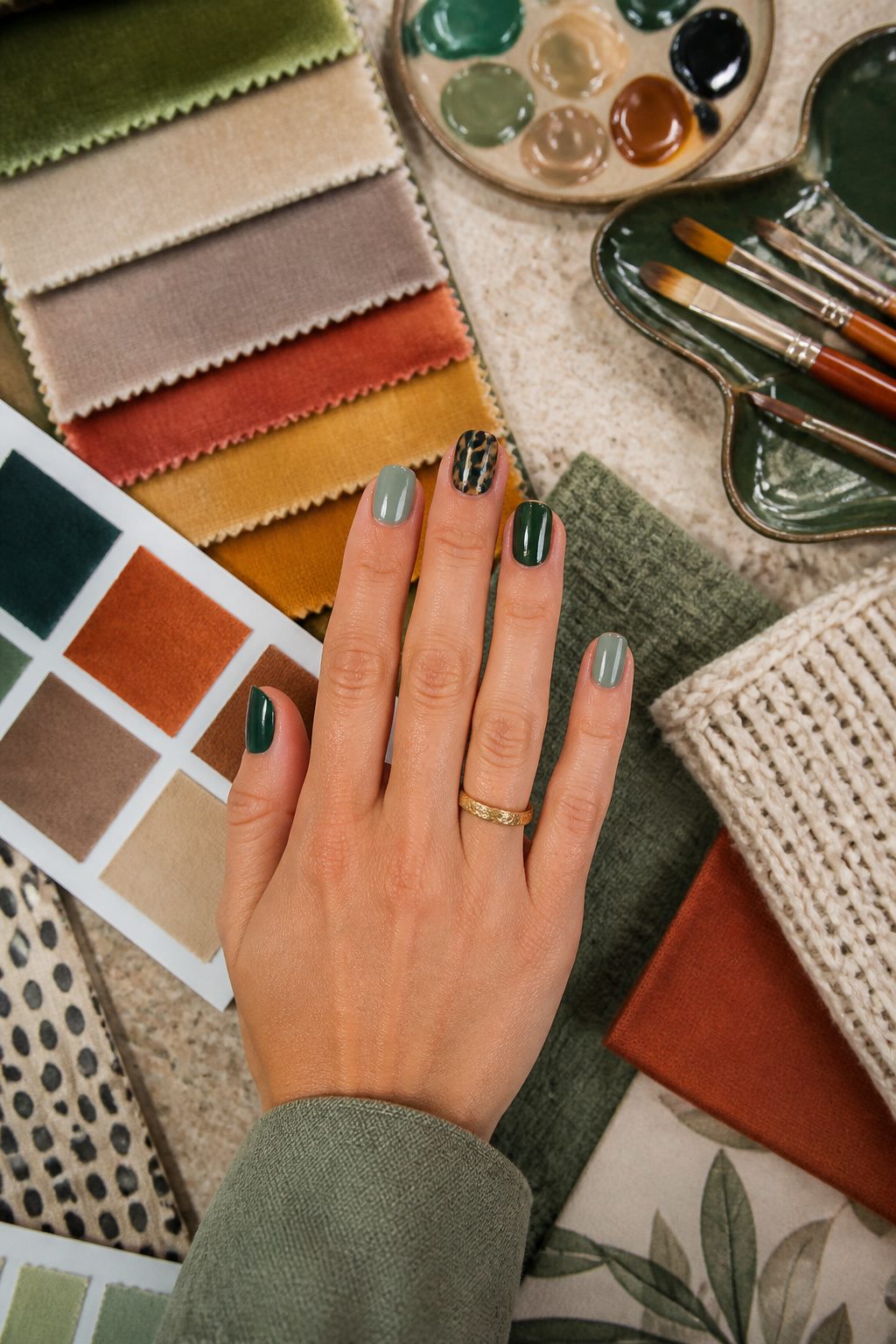
Mismatched green and animal print only works on short nails if you keep the scale small and the placement uneven. A bottle green base on two nails, a soft sage wash on two more, and a single leopard accent on the fifth gives the eye somewhere to rest. Animal print already carries visual weight, so the green tones need to stay in the same family rather than fighting each other. Darker greens create contrast that makes the nail look slimmer, which helps when the print risks emphasizing width.
The mistake is treating mismatched as random. Every nail should share one element: the same glossy finish, the same metallic detail, or the same green undertone. On short nails, one accent nail with animal print is the limit; more than that and the design starts to look like clutter. Geometric or minimalist green designs on the remaining nails, placed off-center or as thin asymmetrical blocks, keep the look deliberate rather than busy. Matte finishes are best avoided here unless you add a glossy contour for dimension, since flat color can make short nails look even shorter.
22. Velvet Tortoiseshell
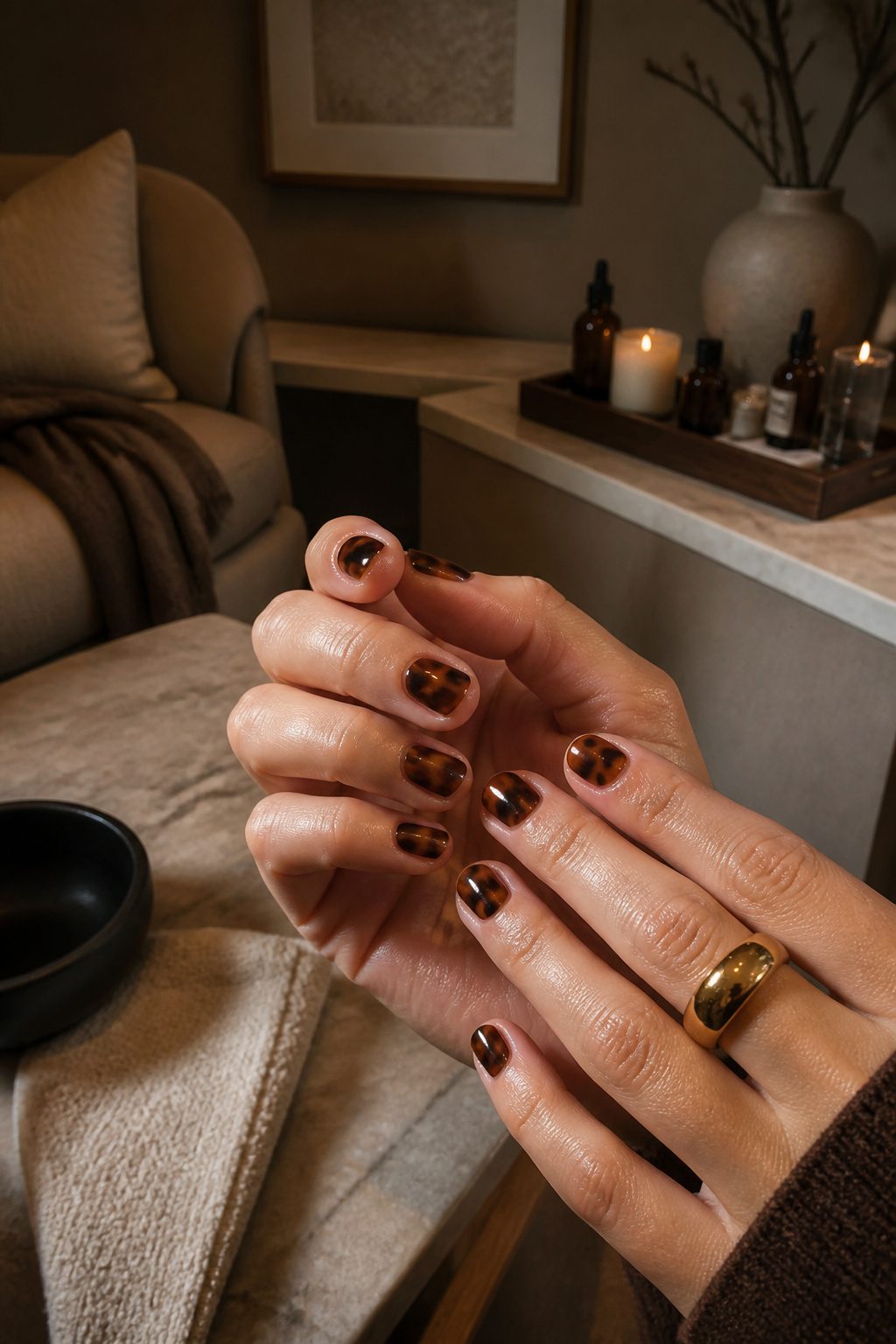
A velvet tortoiseshell finish gives short nails the kind of depth that flat color never quite manages. The base reads as warm amber and espresso swirled together, then matte texture softens the whole thing into something that looks like actual shell rather than sticker pattern. That matte layer does more than look expensive. On short natural nails, it hides the tiny ridges and uneven edges that glossy polish tends to spotlight, especially when nails are still growing out from a break.
The mottling itself is the real trick. Because no two tortoiseshell spots sit in identical placement, the eye reads the overall effect instead of hunting for symmetry at the free edge. A small chip near the corner disappears into the pattern. Growth at the cuticle line shows less dramatically than it would with a solid block of color or a crisp French line.
Application at home takes patience. The marbled effect builds from thin layers of sheer brown and amber polishes, dragged slightly while wet, never fully blended. Rushing it turns the finish muddy. The velvet top coat goes on last, and it must be completely dry before you touch anything; fingerprints in matte texture do not wipe away the way they would on gloss.
23. Invisible French
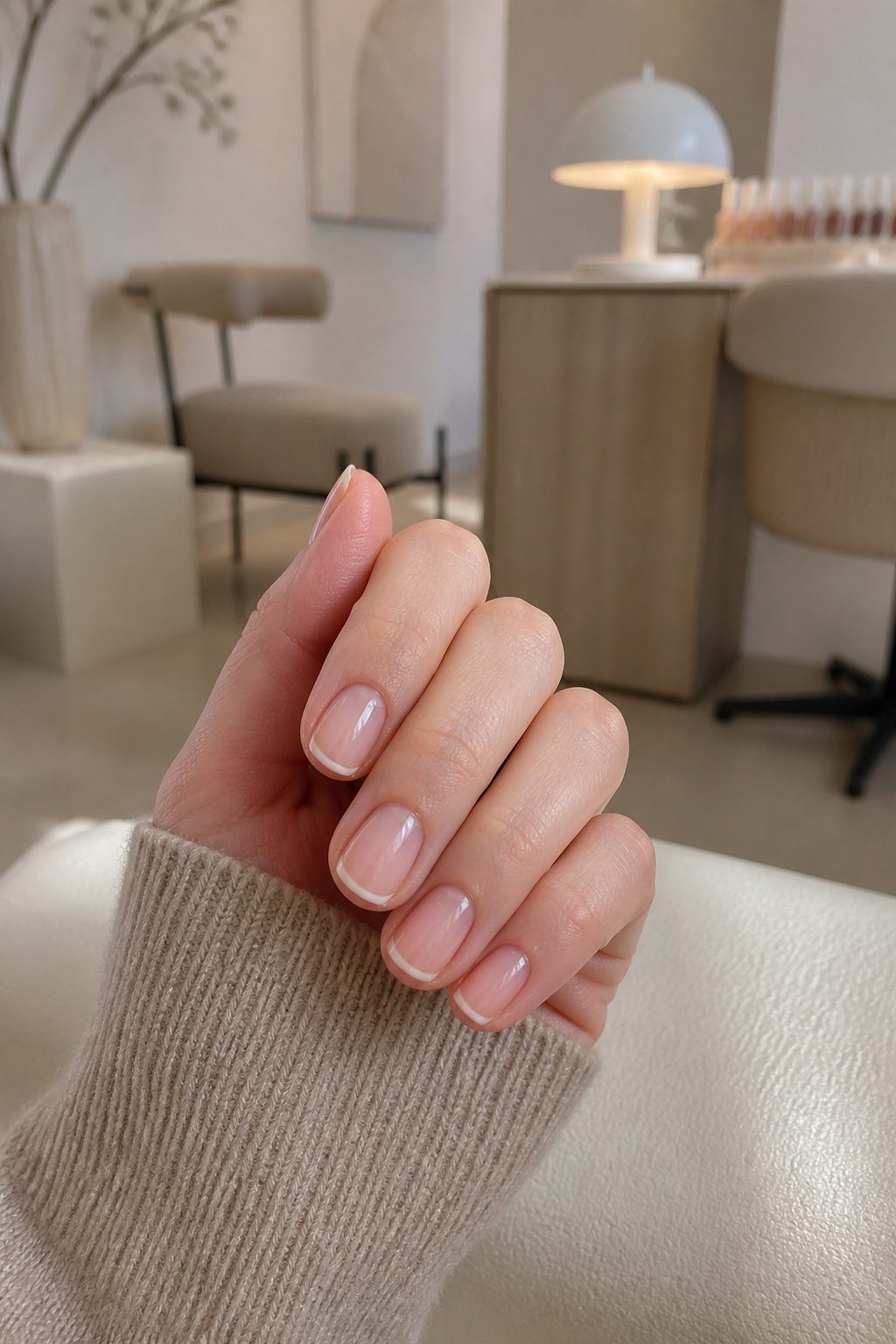
The invisible French is what happens when you want the structure of a classic manicure without the contrast. Jin Soon Choi, who created the look, painted the tip line in a shade only slightly lighter or deeper than the base, so the definition reads as shadow rather than stripe. On short nails, the effect is especially convincing: the eye registers length without any optical tricks that require more surface area to land.
The execution matters more than the color choice. Choi uses a sheer, milky polish over the natural nail line and keeps the edge soft, not crisp. A seamless blend against the nail bed is the whole point; anything that reads as a deliberate line tips the look back into traditional French territory. The result is skin-adjacent, clean in a way that looks almost untouched, which explains why it has taken hold as a spring move rather than a year-round default. Shorter sets carry it as well as longer ones, maybe better, since there is less territory for the gradient to negotiate.
24. Festival Florals
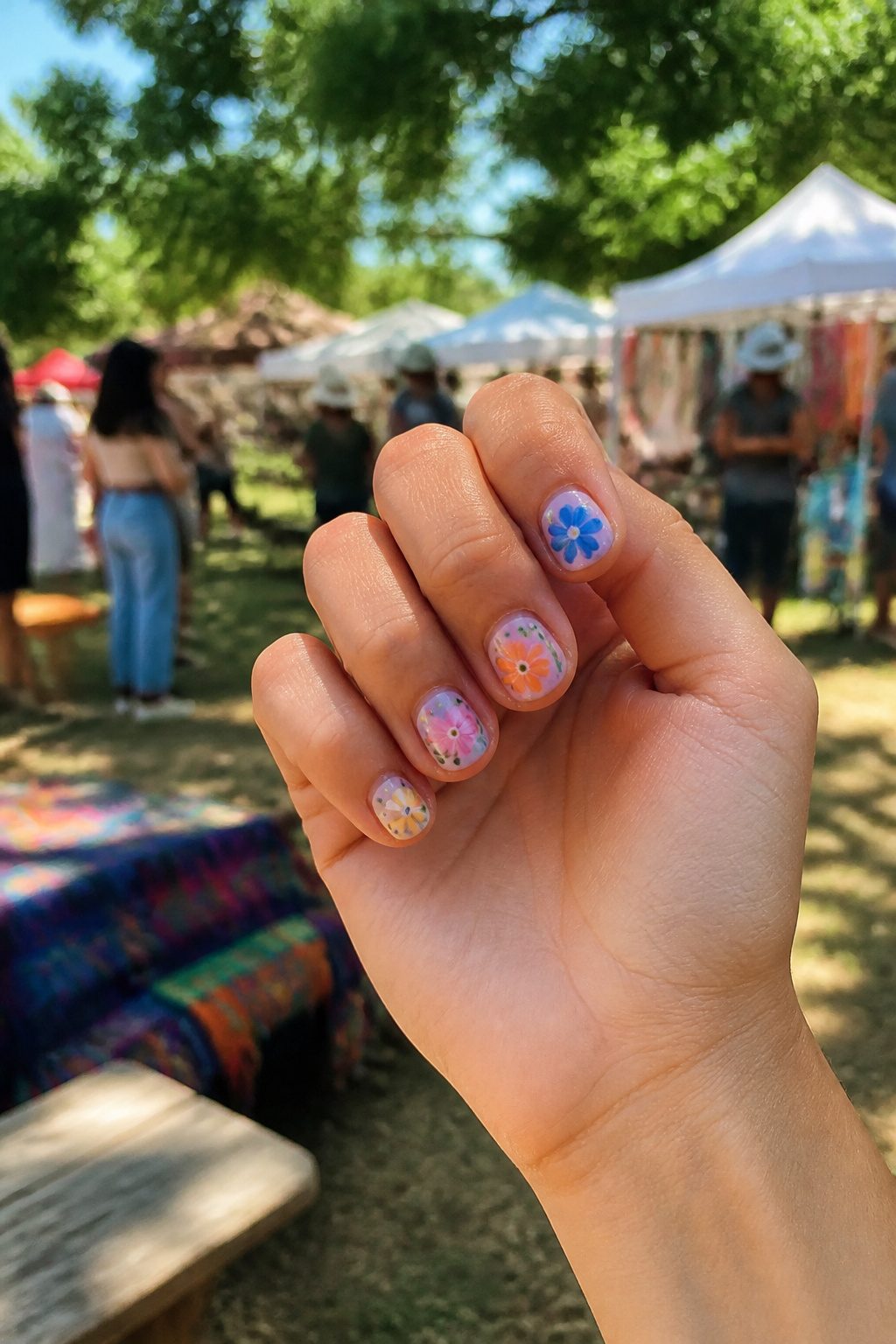
Festival florals pack more color and density than the minimal floral designs that dominate most short nail guides, and that extra saturation is exactly what makes them work for summer weekends. The trick is knowing where the line sits before the pattern starts fighting the nail’s natural dimensions. On a short nail, one medium-sized bloom with a few leaves, or a scattered cluster of tiny buds, carries the look without crowding the surface. Anything that stretches edge to edge, or a design that piles on multiple ornaments per nail, reads as accumulation rather than art and visually shortens what little length you have. A squoval shape helps here; the rounded corners keep the nail from looking blunt or wide underneath all that color, and a glossy or dimensional finish adds depth that matte alone will flatten. I tend to place the heaviest color toward the center or the tip, leaving a sliver of negative space at the base so the eye still sees nail, not just pattern. If the design starts to feel like wallpaper, it is too much for the canvas.
25. Sweetheart French
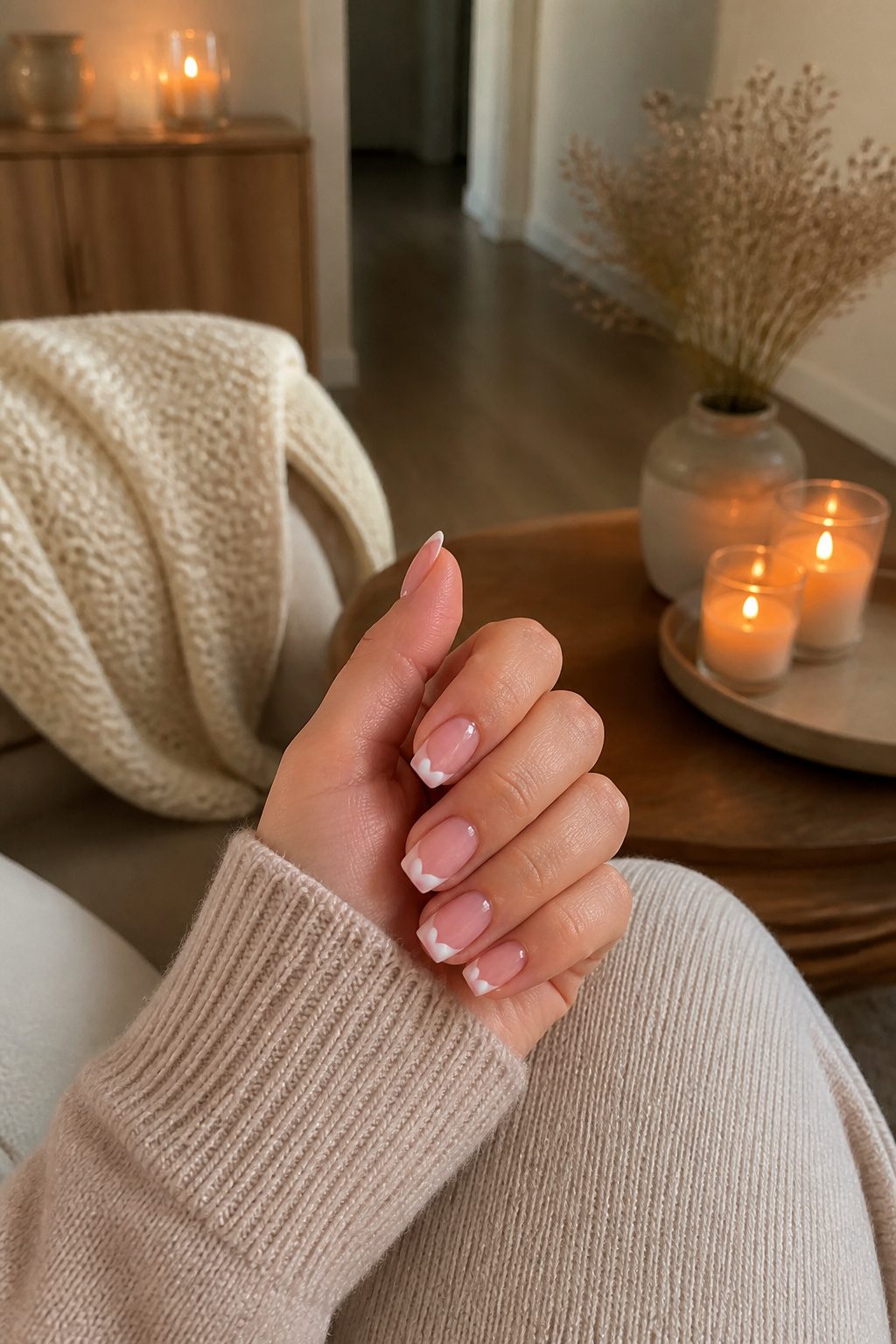
The sweetheart French takes the classic tip line and curves it upward at the center, forming a subtle heart shape where the smile line meets. On short nails, this small romantic gesture reads as intentional rather than gimmicky because the curve sits right where the nail bed naturally ends, drawing the eye upward and making the finger look longer.
What convinced me, looking through dozens of these, is how forgiving the shape is on uneven nail beds. A standard French can look crooked if free edge growth is slightly off; the sweetheart curve masks that by giving the eye a focal point to follow. The key is keeping the heart shallow. Too deep and it crosses into Valentine craft territory; a curve of just two to three millimeters at the center keeps it sophisticated.
Application works best with a thin nail art brush or a curved French guide sticker. Paint the base in a sheer pink or nude, let it dry to a tacky finish, then lay the tip color in two strokes from each side, meeting at the center point. Gel lasts longer for this design since the curved edge sees more contact than a straight line. Skip the glitter topcoat; it competes with the shape itself.
Nail Shapes for Short Nails
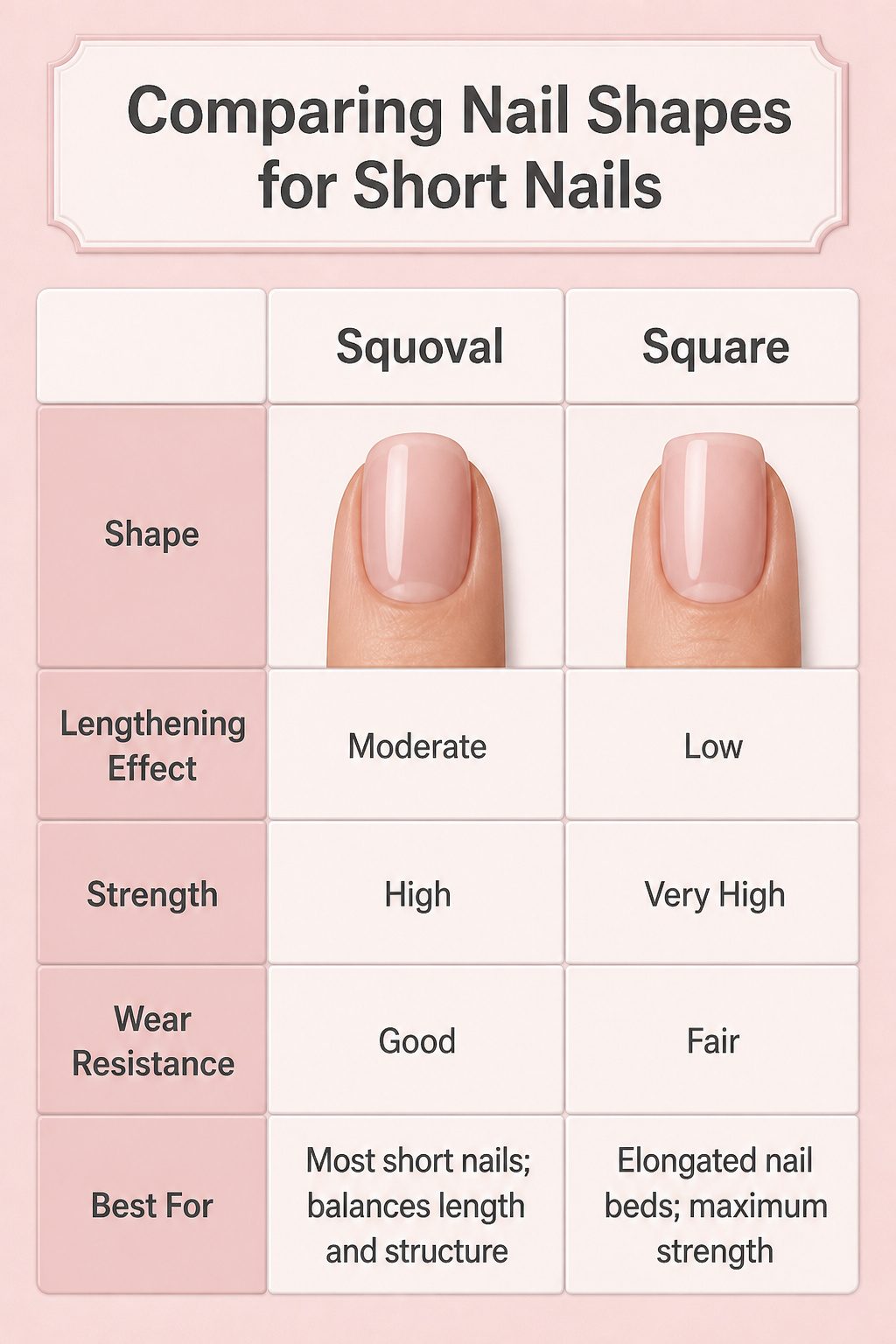
Three shapes matter for short nails, and the choice between them comes down to how much length you want to fake versus how much structure you need.
Squoval sits in the middle on purpose. The flat free edge keeps the strength of a square nail, but the rounded corners soften the silhouette and stretch the visual line so the nail reads longer than it actually is. That combination is why most nail artists file short nails this way first.
A true square can work if your nail bed is already elongated, though on wider or shorter beds the straight edge and sharp corners tend to emphasize width instead of length. Round nails, shaped like a half-circle at the tip, sacrifice the elongating flat edge entirely but hold up well against daily wear and rarely catch or split.
Almond is the shape to skip here. The tapered point needs more runway than short nails provide; without it, the proportion turns sharp and stubby rather than elegant.
Nail Care for Short Nails
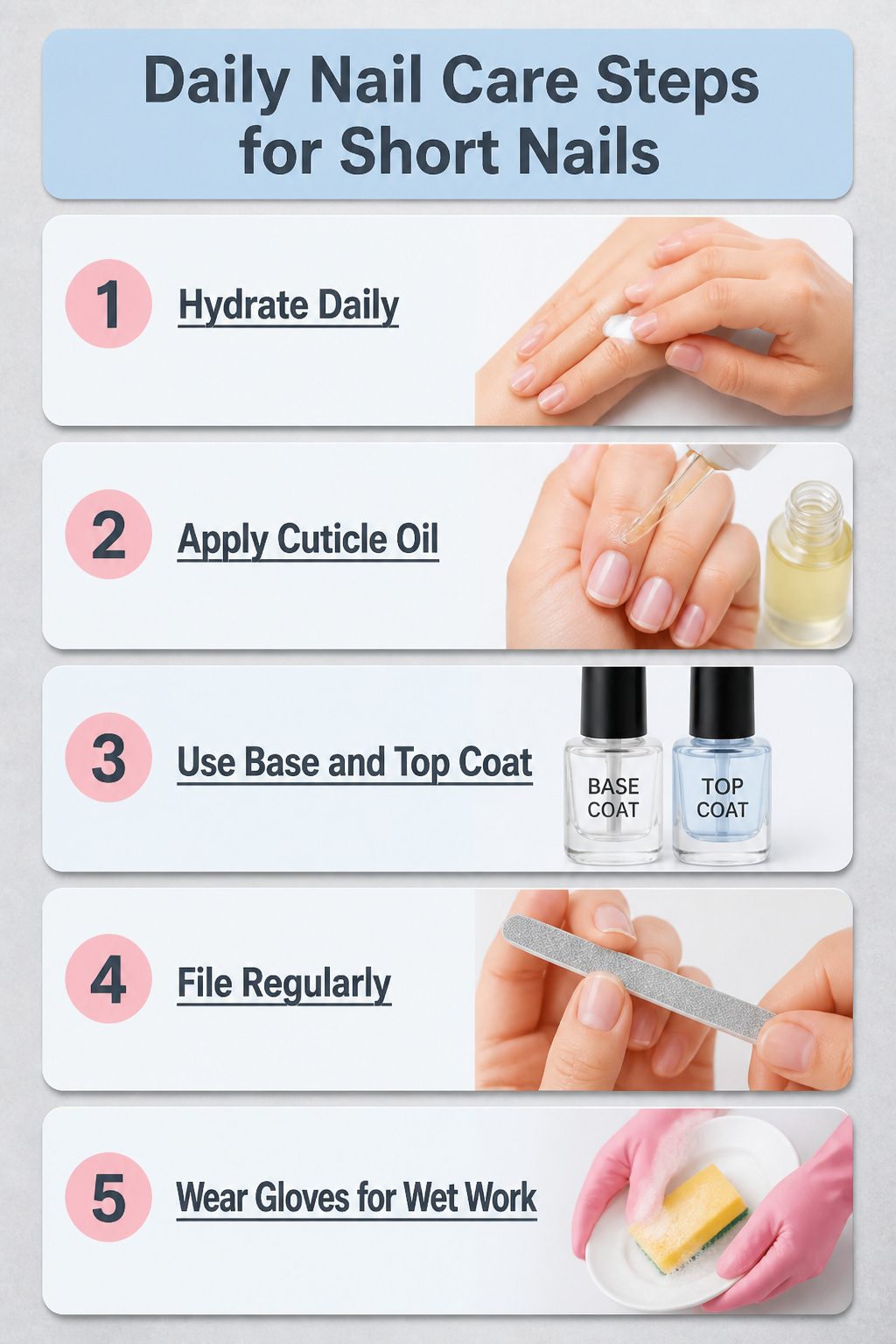
Short nails show every dry patch and ragged edge, so the upkeep matters more than the art. Daily and constant hydration is the key to keeping them from looking dull or brittle. A cuticle oil worked into the nail bed each morning takes maybe ten seconds and pays off in how clean the finished manicure looks. Base coat and top coat are non-negotiable for protection and shine, even if you are skipping color altogether. The base keeps polish from staining, and the top layer seals the edges so the manicure survives a few extra days of typing and dishes. Filing every few days maintains the shape you chose and prevents the snags that turn one broken corner into an emergency trim. Gloves for wet work or chemicals finish the routine; the polish and oil do not matter if you are soaking your hands in dishwater twice a day.
Color Choices That Flatter
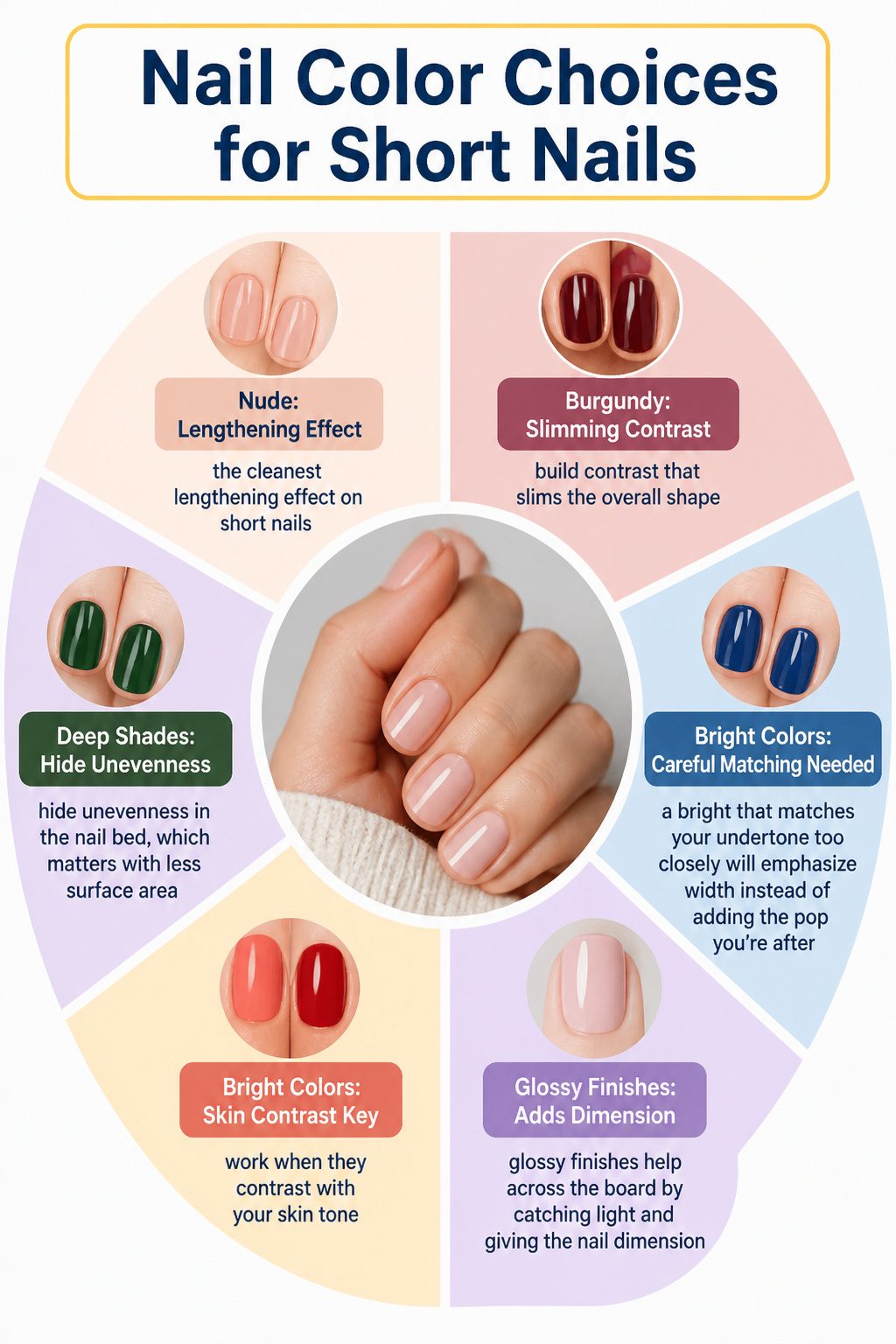
Nude and translucent pink polishes create the cleanest lengthening effect on short nails because they sit close to natural skin tone, which blurs where the finger ends and the nail begins. The eye travels farther, and the nail bed reads as longer than it actually measures.
Darker shades play a different trick. Burgundy, navy, or deep bottle green build contrast that slims the overall shape and reads as more sophisticated than bare nails. These deeper colors also hide unevenness in the nail bed, which matters when you’re working with less surface area to begin with.
Bright colors, coral or classic red or a strong fuchsia, work when they contrast with your skin tone. The manicurists are clear on this: a bright that matches your undertone too closely will emphasize width instead of adding the pop you’re after. Glossy finishes help across the board by catching light and giving the nail dimension; matte finishes in pale shades tend to flatten everything out. Neons without that skin contrast are the one combination to skip.
Seasonal Trends
Short nails are positioned perfectly for the warmer months ahead, and the color stories coming out of spring 2026 feel deliberately practical for the length. Pastel cat-eye finishes in pink, lilac, and periwinkle read as subtle rather than flashy on a shorter canvas, the magnetic shimmer catching light without demanding the real estate a bolder design would need. The effect is dimensional at a scale that still looks finished.
Summer builds on that same restraint. Micro fruit art, strawberries and cherries and lemons scaled down from last year’s trend, works better on short nails than long ones; the motifs stay recognizable without crowding the whole surface. A neutral base keeps it from reading juvenile, which matters when the temperature climbs and the rest of your look strips back.
What surprised me, looking at how these two seasons flow together, is that nautical stripes are being treated as a spring move rather than waiting for July. A navy-and-white French variation feels crisp against bare skin while the weather is still mild, then transitions into poolside territory without a redo. Short nails make the maintenance of that transition lighter, too; growth shows less, and a chip matters less when the overall shape stays neat.
Frequently Asked Questions
What are the best nail shapes for short nails?
Square, round, and squoval nails are all great choices for short lengths, but squoval is the most flattering. The flat tip with rounded corners maintains the strength of a square base while softening the look and creating an illusion of greater length. Sheer square can work on naturally elongated nail beds, but on wider or shorter nails it can look coarser. Almond shapes need more length to avoid looking pointy or disproportionate.
How can you stop nail polish from chipping on short nails?
Prep and maintenance matter more than the polish itself. Remove oils from the nail with an alcohol wipe before painting, and let each layer dry completely before applying the next. Wear gloves for dishwashing and other chores because water and harsh chemicals cause polish to lift.
Are short nails compatible with nail art trends?
Short nails work well for nail art when you choose designs that enhance them rather than fight the limited canvas. Nail artist Tom Bachik does not let nail shape determine his designs, and the article lists twenty-five specific options, from micro-French tips to cat-eye magnetic polish, that suit shorter lengths. The key is keeping details small, placing elements vertically, and leaving breathing room around each design.