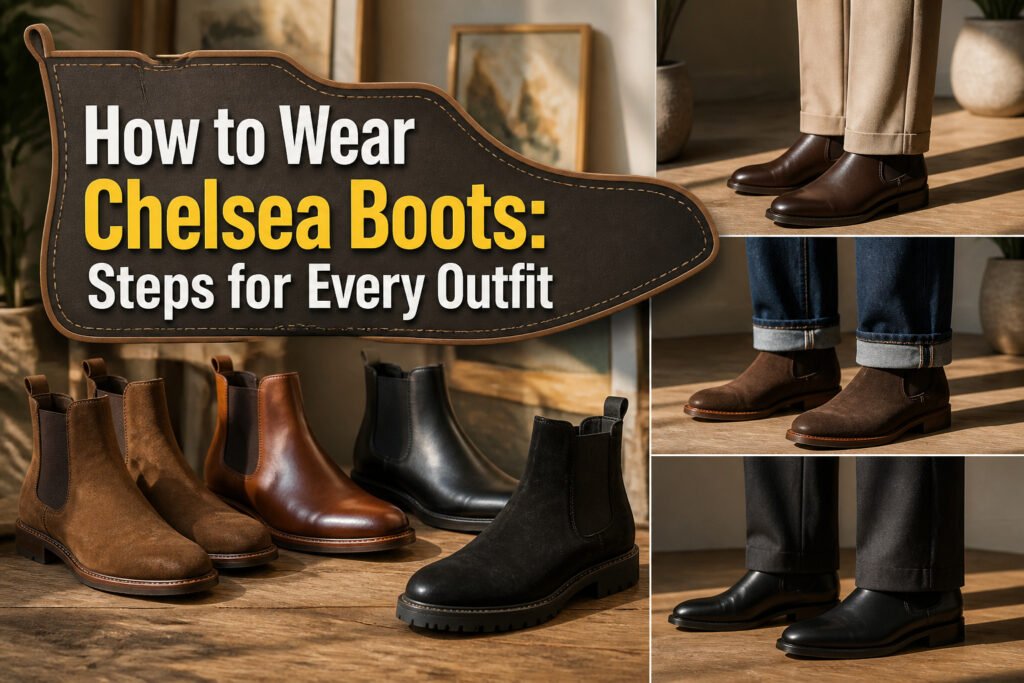
The right Chelsea boot costs about $220 and up, and the pair you choose decides which of your clothes still work. Suede tilts toward casual, smooth leather dresses up to a suit, and the sole thickness either grounds a wide leg or keeps a slim line clean. The hem length most people get wrong is the one that sits right at the boot shaft: too long and the denim pools, too short and the gap shows skin you did not plan for.
1. Choose Your Chelsea Boot Style

The elastic gussets on each side are what make a Chelsea boot a Chelsea boot, not just another ankle boot. Pull the boot on and the gussets stretch to let your foot pass; once you’re in, they rebound to hold the shaft snug against your ankle without laces, buckles, or zippers to break the line.
Leather reads as the more formal choice. Boxcalf or smooth full-grain leather in black or dark brown will dress up as far as a suit and outlast years of hard wear. Suede tilts the same silhouette toward casual territory, lending texture that works with linen, lighter tailoring, or any outfit where polished leather would feel overdone. The tradeoff is weather vulnerability: suede protection should go on before the first wear, not after the first soaking. Cream and wax polish are the wrong tools here, since both flatten the nap instead of shielding it.
Sole thickness matters too. A chunky sole grounds wide-leg trousers and casual looks; a sleek, thinner sole keeps the profile refined with slim pants or formal tailoring.
Quality pairs run roughly $220 to $349. At that price you’re getting full-grain leather or premium suede, solid construction, and the elastic that won’t sag after a season. Cheaper versions exist, but the gussets are usually the first thing to go, and once they stretch out the boot no longer stays up.
2. Match Skinny Jeans for a Sleek Line

Skinny jeans and Chelsea boots share the same goal: a clean vertical line from knee to floor. The hem should stop right at the top of the boot shaft, letting the boot slip over the denim without swallowing it or leaving a gap. Anything longer pools at the ankle and breaks the silhouette; anything shorter exposes skin and breaks it too.
I learned this the hard way with a pair I hemmed an inch too long. The fabric bunched where the boot shaft began, creating a ridge that read as an extra ankle I didn’t have. A tailor took them up to true ankle height and the look clicked into place.
A cuff seems like a quick fix but stacks bulk exactly where the boot needs to stay slim. Tucking the jean into the shaft does the same, adding a gathered line under the hem that the eye catches immediately. The sources agree here almost unanimously: keep the jean slim, keep the hem uncuffed, and let the boot do the work of finishing the line.
3. Let Straight-Leg Jeans Graze the Boot Top

Straight-leg jeans and Chelsea boots live or die at the hem. Too long and the denim pools over the shaft, swallowing the boot’s clean line. Too short and you’re left with an awkward gap of skin or sock that breaks the silhouette in exactly the wrong place. What convinced me, reading through a dozen of these guides, is that the hem should just graze the top of the boot, touching it lightly without bunching above or hovering below.
A tailor can get you there, or you can buy the crop built in. The sources split on whether to let the hem cover the shaft slightly or stop right at it, so the choice is yours: a cleaner break that shows the full boot, or a half-inch overlap that reads a touch more relaxed. Either way, skip the cuff. A turn-up stacks bulk where the boot already sits, and the point of this pairing is the smooth vertical line from knee to toe. The same rule carries to chinos: slim, tapered, ending at the ankle with no break.
4. Wear Wide-Leg Jeans Over the Boot

Wide-leg jeans change how a Chelsea boot reads from the ankle down. The boot’s elastic gusset and slim silhouette disappear beneath the denim, so the foot becomes a dark, finished point at the bottom of a long line rather than a visible feature. The hem should cover the boot slightly, breaking just at the instep or upper. Too short and the proportions look accidental; too long and the fabric pools in a way that drags the eye downward.
This approach trades the boot’s signature detail for something quieter. Where cropped denim puts the gusset on display, this styling lets the jean lead and the boot support. The visual weight shifts from the ankle upward, which can balance a heavier top half or a structured coat.
A heel height of one to two inches helps here. Flat boots can read stubby once the leg line is interrupted, while a little lift keeps the stride from looking truncated. Suede works better than polished leather for this particular pairing; the softer texture catches less light where the hem skims it, so the transition reads smoother.
5. Show Ankle With Cropped Jeans

A cropped hem is the single best way to let a Chelsea boot do what it was built to do. The jeans should end at the ankle or just above it, leaving a narrow band of skin between the denim and the boot shaft. That gap is deliberate; it frames the elastic gore and the boot’s clean line instead of burying it under fabric.
Socks turn into part of the outfit here, not an afterthought. A flash of patterned wool or a thin ribbed knit reads as intentional when it sits in that exposed zone. Solid charcoal or tan keeps the look quiet; something striped or marled makes it a statement. Either way, the sock should be tall enough that no bare leg shows when you sit down.
Some pairs sold as cropped already hit this length. If yours don’t, a tailor can hem straight-leg or slim jeans to the right spot without adding a cuff. Cuffs stack bulk right where the boot is sleekest, and tucking denim into the shaft distorts the shape entirely. I learned that the hard way on a pair I tried to roll myself; the ridge sat wrong for hours and I gave up by lunch.
6. Tuck Leggings Into the Boot

Leggings should always be tucked into the shaft, never pulled over the top. This pairing is where the Chelsea boot functions most like a shoe rather than a boot, and the elastic side panels do the visual work for you.
The slim line of a legging disappears cleanly into the boot opening, so the whole thing reads as one continuous leg. A sock in a matching or neutral tone keeps the transition invisible. Anything bulky at the ankle breaks that line and turns the boot into a stump.
This is the fastest way to wear Chelseas and the one that needs the least thought. The boot becomes a sleek alternative to a ballet flat or loafer, but with more structure and better weather coverage. Dark leggings with black or brown suede boots is the combination that gets the most mileage, though a cognac leather against charcoal works for days when you want the boot to show.
7. Balance Skirts and Dresses Against Boot Weight

A chunky Chelsea boot can swallow a lightweight skirt whole if you let it. The visual weight sits low and square, so the upper half needs something to answer back. Tweed or wool on the bottom does some of that work itself; a heavier fabric down there meets the boot rather than disappearing under it. With a flowier dress or something that skims the body, the balance has to come from somewhere else. A sweater dress with tights handles it in one piece, or a heavier jacket layered over something lighter shifts the weight upward so the boot does not dominate.
The ankle line is where this gets tricky. Chelsea boots cover the narrowest part of the leg, which can read as a hard stop. A chunky sock that shows above the boot, or tights that keep the line continuous, keeps the silhouette from looking cut off. Midi and maxi hemlines that hit at mid-calf fight the boot and break the leg in the wrong place; either go shorter or let the hem fall low enough that the boot becomes a footnote. Pleated skirts work because the volume there plays against the boot’s structure without competing on the same level.
8. Try Chinos for Smart-Casual

Chinos land exactly where most outfits need to be: sharper than denim, less formal than suit trousers. The fabric is lighter and cleaner, which lets the boot become the anchor rather than competing with heavy twill.
The same hem rule applies. Slim or tapered, cropped at the ankle so a sliver of boot shows below. Too long and the chino leg pools over the shaft; too short and the gap looks accidental, not intentional. I learned this the hard way with an old pair cut straight through the leg, the extra cloth ballooning over the elastic panel until the whole silhouette went sloppy.
Suede Chelseas work here in ways they rarely do under tailoring. The texture plays against the smooth cotton without looking underdressed for a dinner reservation or an office that skips ties. Smooth leather shifts the same outfit toward evening. Either way, the chino does the mediating, and the boot gets to decide the tone.
9. Add Shorts for Casual Warm-Weather Wear

Shorts with Chelsea boots show up in exactly two kinds of photos: street-style shots from Fashion Week and the occasional "riskier than it looks" tip in a style roundup. The pairing reads cheeky rather than practical, which is probably why so few people actually wear it to the grocery store.
If you want to try it, the workable version borrows from cold-weather logic rather than summer ease. A ribbed sweater and a long coat on top lets the shorts and boots read as deliberate, not confused about the season. The boots themselves should probably be the statement: knee-high Chelseas or a chunky cleated sole anchor the bare leg rather than floating beneath it.
"But don’t be afraid of getting playful with a visible sock, either," Pierson explains, pointing out that at a recent photoshoot for her brand, model Yan Yan Chan "paired a suede Chelsea boot with tailored shorts and chunky socks. It looked fresh and cool."
— Vogue
That sock detail matters more than the shorts do. Without it, the gap between boot top and hem can look accidental; with a thick knit sock peeking out, the whole thing becomes intentional proportion play. Suede handles this better than polished leather, which can tip into costume territory fast.
Breathable suede uppers in tan or stone stretch the idea into actual warm weather, though honestly a loafer or sandal still wins for comfort once the temperature climbs past mild. This combination works best on days when you want the boot’s structure without committing to full coverage, which makes it more mood than wardrobe staple.
10. Wear With Tailored Suits for Polish

A black leather Chelsea boot alongside a charcoal or navy suit is a legitimate choice for business formal, and the boot’s clean, laceless silhouette reads as dress footwear when the leather is smooth and well-polished. The trick is the trouser cut: no break at the ankle, with a clean line from trouser to boot shaft. Very wide-legged suit trousers swallow the slim silhouette entirely, so slim to straight-cut tailoring is where Chelsea boots belong.
For something with more personality, a tan or dark brown leather Chelsea boot with mid-grey or navy is arguably more interesting than an Oxford. Dark brown pairs with navy, mid-grey, or camel suits; tan works with navy, stone, cream, or mid-grey for summer tailoring. Suede Chelseas sit best with lighter-weight suits in navy, stone, or khaki, and a dark brown suede pair with a charcoal suit makes for an unexpected combination that still holds its own in a formal setting.
History of the Chelsea Boot

J. Sparkes-Hall designed the first elastic-sided ankle boot in 1851, a full fourteen years after Queen Victoria took the throne in 1837. The boot maker to the Queen filed a patent that year claiming, in his own words, that "She walks in them daily," giving what he called the strongest proof of the value she attached to the invention. That elastic panel, made possible by vulcanized rubber, was the real breakthrough: Charles Goodyear had patented his process in 1844, and Thomas Hancock secured a British patent the same year for the same discovery. Either way, the material allowed a boot that slipped on without buckles, hooks, buttons, or laces.
By 1896 the style was established enough to appear in catalogues and illustrations under the name we still use. The heel stayed low, the height ankle-cut, the pull-on loops a constant. The silhouette that started as royal footwear became workwear, then mod uniform, then a standard I reach for in rain or shine without thinking about it. Nearly two centuries on, the same construction Hall patented still defines the boot.
Leather Care and Suede Protection

Suede Chelsea boots need protective spray applied before the first wear, not after the first puddle. The nap opens up when the leather is new and accepts treatment best then; once water hits unprotected suede, the stain sets below the surface where brushing cannot reach.
Leather pairs follow a different path entirely. Cream or wax polish feeds and seals the grain, and a pass every few weeks keeps the creases from cracking. Suede, though, gets ruined by those same products: wax flattens the pile instead of shielding it, so keep the two routines separate.
When boots do get soaked through, let them dry well away from any heat source. A radiator will stiffen the leather and shrink the fit. Once fully dry, brush the nap to lift the pile, then repeat every few weeks or after hard wear.
Sock Choices That Complete the Look

Socks can make or break the comfort of Chelsea boots, but they also shift the whole look of an outfit. Hidden socks keep the line sleek, especially with leggings in a single color where you want no break between boot and pant. A little peek of sock works better with cropped jeans or shorter hemlines, where the gap needs filling.
Ruffled socks that show just above the boot add an unexpected, almost accidental touch of style. When the temperature drops, thicker socks trade that subtlety for warmth, and the boot still slips on cleanly because the elastic goring accommodates the bulk. The choice between visible and hidden comes down to what the rest of the outfit is doing. Monochrome looks usually want the sock out of sight; anything with more visual weight up top can handle the detail down low.
Frequently Asked Questions
What kind of pants can you wear with Chelsea boots?
Skinny jeans, straight-leg jeans, wide-leg jeans, cropped jeans, leggings, and chinos all work. The key is matching the hem length to the boot shaft: skinny jeans end right at the top, straight-leg hems graze the boot, wide-leg covers it slightly, and cropped leaves a narrow gap of ankle or sock showing.
Do Chelsea boots go over or under jeans?
Skinny jeans always go over the boot shaft to maintain a clean line. Wider styles like straight-leg or wide-leg can go under, with the hem skimming or covering the boot top. Cropped jeans let the boot stand alone entirely.
What socks should I wear with Chelsea boots?
Hidden socks keep a sleek line with leggings or monochrome outfits. A visible sock works with cropped jeans or shorter hemlines, where the gap between boot and hem needs filling. Ruffled socks add style; thicker socks trade subtlety for warmth in cold weather.
Are Chelsea boots still in style?
Yes. The silhouette J. Sparkes-Hall patented in 1851 has persisted through royal wear, workwear, and mod fashion to become a standard that works in rain or shine. Full-grain leather or premium suede pairs running $220 to $349 will last years without the elastic gussets sagging.